.webp)
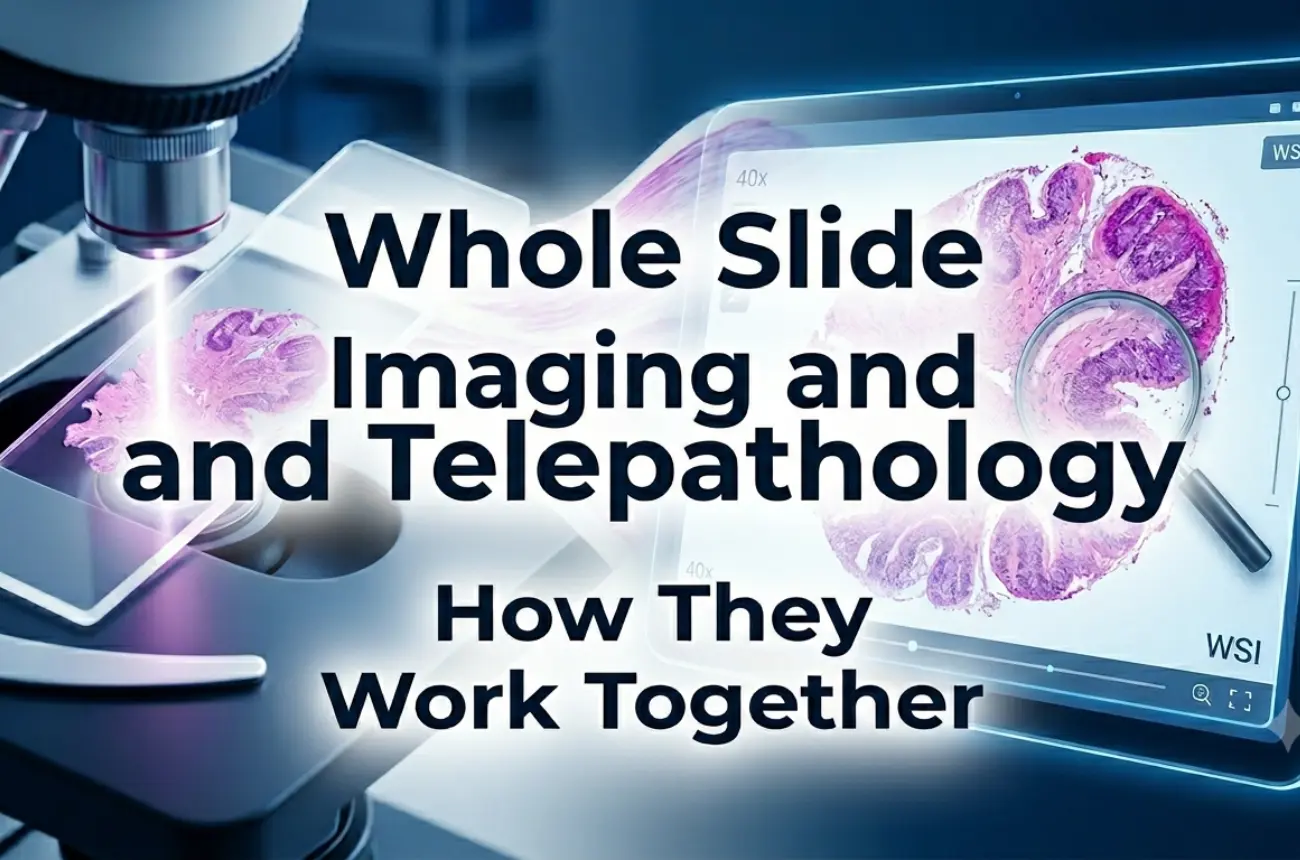
A Whole Slide Imaging (WSI) system plays a critical role in both clinical diagnostics and research; but the requirements, priorities, and success metrics differ significantly. From regulatory compliance and diagnostic confidence in clinical labs to flexibility and experimentation in research settings, understanding these differences helps organizations choose the right Digital pathology scanner and avoid costly mismatches.
Whole Slide Imaging System
A digital pathology solution that converts glass slides into high-resolution digital images for viewing, analysis, storage, and sharing.
Digital Pathology Scanner
The core hardware component of a WSI system that captures entire slides at diagnostic resolution. Scanner performance directly impacts workflow reliability, image quality, and downstream applications.
Whole Slide Scanning
The process of digitizing an entire tissue section, enabling microscope-like navigation across magnifications.
While the same technology underpins both applications, the expectations from a WSI system differ sharply.
Clinical pathology prioritizes accuracy, consistency, and compliance. Research environments prioritize flexibility, experimentation, and scale. Selecting a scanner without clarity on this distinction often leads to underutilized features; or critical gaps.
In clinical diagnostics, WSI workflows are tightly controlled:
Here, scanners must behave predictably every day, across shifts and users.
Research workflows are more exploratory:
A Microscope Scanner used for research must support experimentation without rigid constraints.
Clinical environments demand consistent focus, color fidelity, and reproducibility; especially in Slide Scanner Histology workflows where subtle morphology drives diagnosis.
Research labs may tolerate variability if it enables faster throughput or novel analysis.
Clinical labs benefit from an automated microscope slide scanner that minimizes manual handling and reduces error risk.
Research labs may prioritize flexibility over automation, especially when handling non-standard samples.
Clinical WSI requires secure storage, traceability, and long-term archival. Research environments prioritize access speed, large datasets, and compatibility with analysis pipelines.
For clinical labs, Digital Pathology Scanner price must be weighed against diagnostic reliability. For research labs, scalability and flexibility often matter more than compliance features.
Both rely on the same WSI foundation; but demand different scanner behavior.
Before investing in a WSI system, labs should ask:
Intended Use
Will slides be used for primary diagnosis or research only?
Performance Requirements
Is image consistency or flexibility more important?
Automation Level
Does the workflow require unattended scanning?
Scalability
Will slide volumes increase over time?
Total Cost of Ownership
Beyond Digital Pathology Scanner price, what are the long-term storage and operational costs?
Aligning scanner capabilities with use cases prevents overspending or underperformance.
The line between clinical and research WSI is narrowing due to:
Future WSI systems will increasingly need to support both worlds; without compromise.
Morphle Labs develops digital pathology scanners designed to adapt to both clinical and research environments. By focusing on consistent image quality, configurable workflows, and scalable architecture, Morphle supports labs across the diagnostic-to-discovery spectrum.
Rather than forcing labs into rigid use cases, Morphle Labs enables a balanced approach; supporting validated clinical workflows while remaining flexible enough for research and AI innovation.
Choosing a Whole Slide Imaging system is not just a technology decision; it’s a strategic one.
Whether your lab is focused on diagnostics, research, or both, selecting the right Digital pathology scanner ensures long-term value, reliability, and scalability. Explore how Morphle Labs can help you deploy a WSI system aligned with your clinical and research goals; today and into the future


.webp)
.webp)
.webp)
.webp)
.webp)
.webp)