Whole Slide Imaging and Telepathology: How They Work Together

Discover how Whole Slide Imaging and telepathology work together to transform remote diagnostics — and how Morphle Labs' digital pathology scanner leads the way.
4 mins

Whole Slide Imaging (WSI) and tele-pathology are no longer separate disciplines; they are two sides of the same coin. A high-performance digital pathology scanner converts glass slides into richly detailed digital files that pathologists can review from anywhere in the world. This blog breaks down how the two technologies integrate, why it matters for diagnostics, and what to look for when choosing the right scanning solution.

What You'll Learn

  • What Whole Slide Imaging and telepathology mean individually and together
  • How the end-to-end workflow operates
  • The technical factors that determine scan quality
  • Key benefits, limitations, and compliance considerations
  • Real-world applications, buying checklist, and future trends

Defining the Technologies

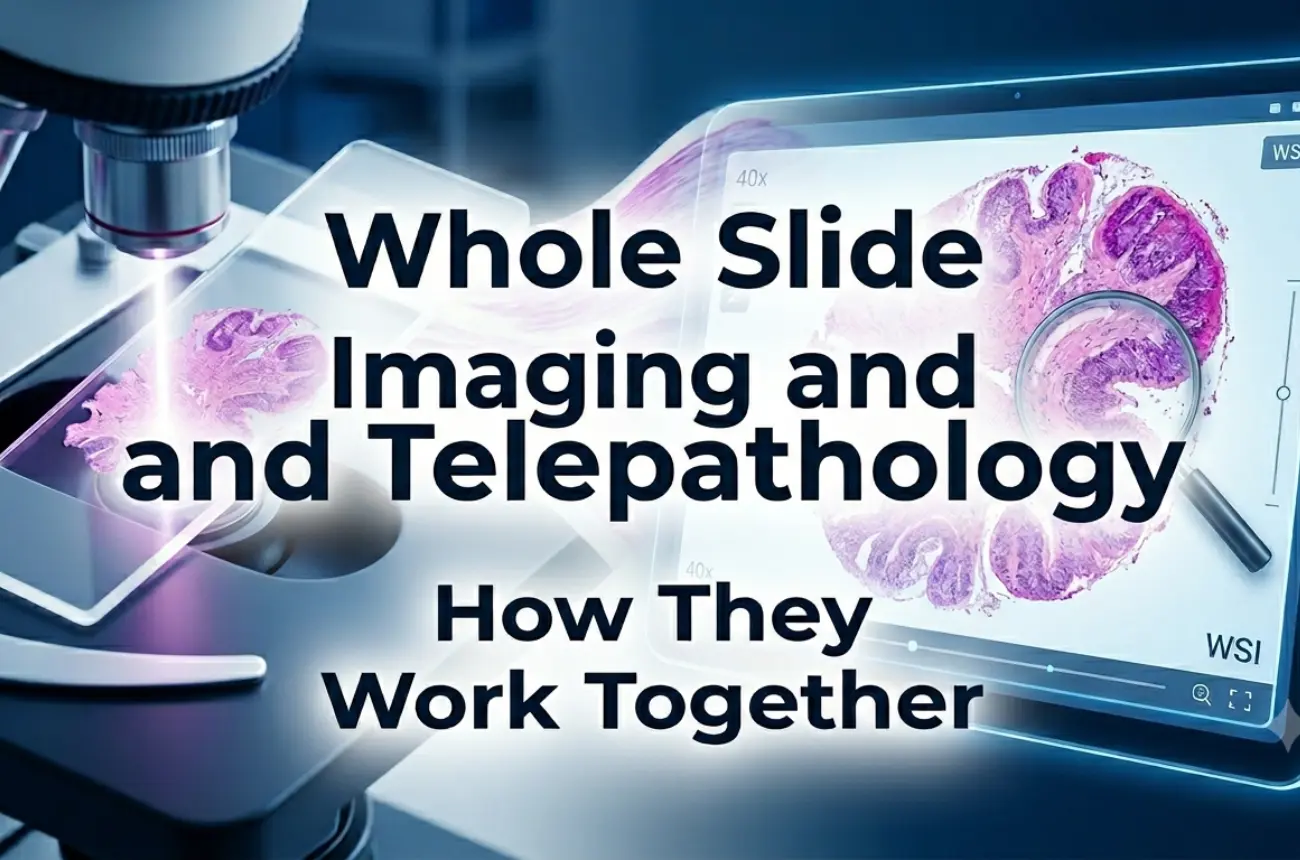
Whole Slide Imaging (WSI) refers to the process of digitizing an entire glass slide at high resolution using an automated microscope slide scanner. The output, a whole slide image, replicates the optical fidelity of a conventional microscope, but in a shareable, zoomable digital format.

Telepathology is the transmission of pathological data, images, annotations, reports, over electronic networks for the purpose of remote diagnosis, second opinions, or education

Historically, telepathology relied on static JPEG captures or real-time robotic microscopy. WSI changed the equation entirely. Instead of sending a single field of view, a digital pathology scanner now captures the full tissue section, giving the remote pathologist complete contextual visibility, the same view they would have at the bench.

How the Workflow Operates

The integrated WSI-telepathology workflow follows a clear sequence:

  1. Tissue preparation — Biopsy or surgical specimen is fixed, embedded, sectioned, and stained (H&E, IHC, or special stains).
  2. Slide scanning — A digital pathology scanner scans the glass slide at 20× or 40× magnification, producing a high-resolution whole slide image.
  3. Image storage and management — Files are uploaded to a Laboratory Information System (LIS) or a dedicated digital pathology platform with cloud or on-premise storage.
  4. Remote access — An authorized pathologist accesses the image from any location through a secure web viewer, navigating the slide as they would under a microscope.
  5. Diagnosis and reporting — The pathologist annotates, reports, and signs out the case digitally.

This pipeline compresses what once required a physical courier service for slides into a process that can be completed in minutes.

Technical Factors That Determine Quality

Not all scanning systems deliver equal results. These are the parameters that matter most:

Optical resolution determines the finest detail that can be resolved. Most diagnostic workflows require 0.25 µm/pixel (40× equivalent) for cytology and high-detail morphology, and 0.5 µm/pixel (20× equivalent) for routine histology.

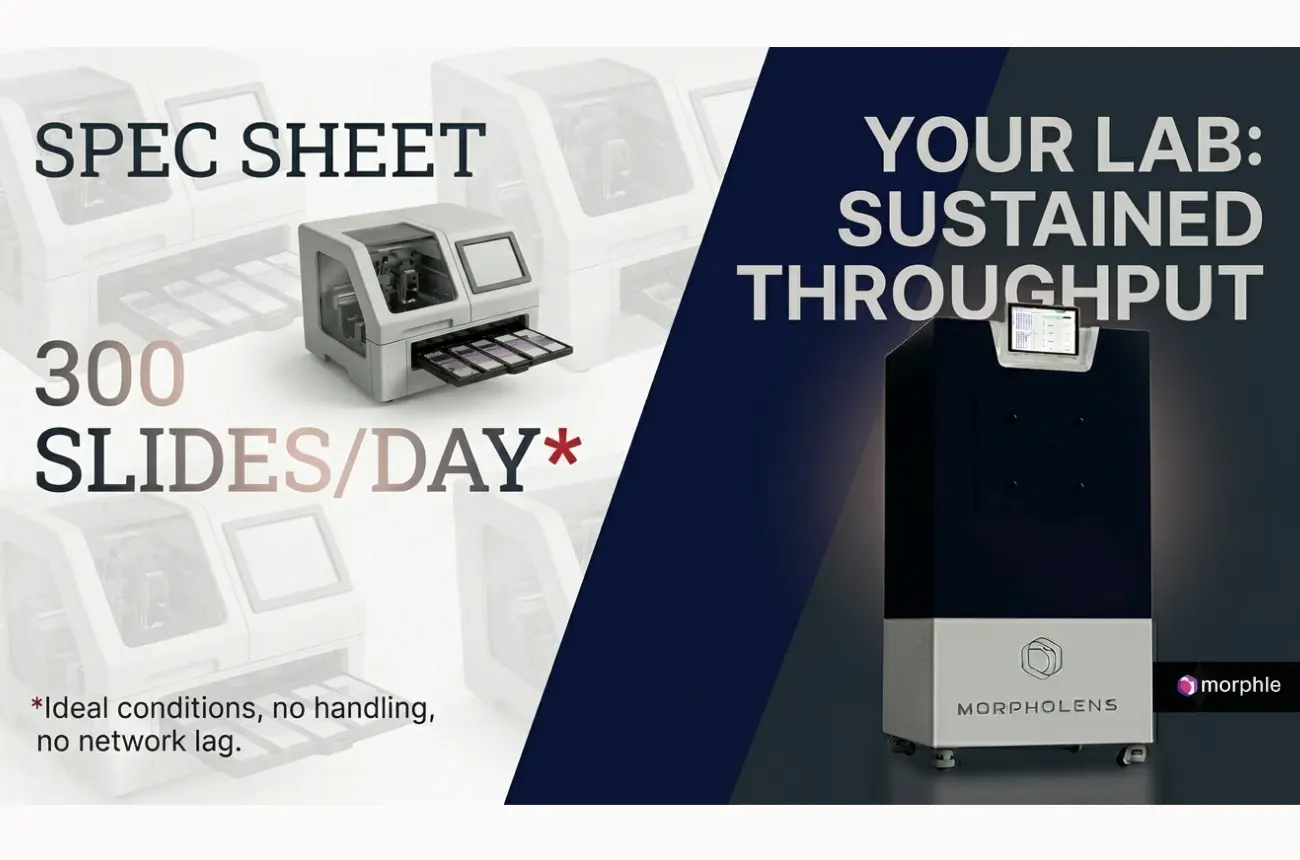
Scan speed directly impacts lab throughput. Enterprise labs processing hundreds of slides daily need scanners that can complete a standard slide in under 60 seconds.

Focus accuracy — both pre-scan focus mapping and real-time z-stack adjustment- is essential for uneven tissue sections common in slide scanner histology applications.

File format and compression affect storage costs and image fidelity. Formats such as SVS, NDPI, and TIFF are industry standards; lossless compression preserves diagnostic accuracy.

Connectivity and integration — compatibility with DICOM standards, LIS/PACS integration, and API access are non-negotiables for seamless telepathology deployment.

Benefits vs. Limitations

Benefits

  • Geographical reach — Expert pathologists can review cases from rural hospitals, low-resource settings, or entirely different countries without slides ever leaving the lab.
  • Speed — Digital turnaround times dramatically reduce time-to-diagnosis, especially for frozen section consultations.
  • Collaboration — Multiple specialists can review the same slide simultaneously, eliminating sequential delays.
  • Archiving — Digital slides never fade, break, or get misplaced. A well-managed archive gives institutions a permanent, searchable pathology record.
  • AI-readiness — WSI files are the input layer for computational pathology algorithms, enabling automated quantification and pattern recognition.

Limitations

  • Upfront infrastructure cost — High-quality digital pathology scanner hardware and accompanying IT infrastructure represent significant capital investment.
  • Storage demands — A single whole slide image can range from 1 GB to 5 GB; labs scanning at scale require robust storage strategies.
  • Regulatory variability — Primary diagnosis from WSI is cleared in some jurisdictions (FDA 510(k) in the US, CE-IVD in Europe), but regulatory status differs by country and use case.
  • Internet dependency — Telepathology performance is contingent on network reliability; low-bandwidth environments can impair real-time viewing.

Real-World Applications

Frozen section consultation — Intraoperative slides are scanned and transmitted to an off-site pathologist for real-time surgical guidance, eliminating the need for on-call pathologists at every surgical facility.

Second opinion and tumor boards — Complex or rare cases benefit from multi-institutional input. WSI enables seamless sharing without the risk of slide loss or degradation.

Histology research and education — Universities and research centers use whole slide scanning to build digital teaching archives. Students navigate real diagnostic cases at full resolution, regardless of location.

Low-resource and developing-market diagnostics — Portable and compact digital pathology scanners are bringing specialist-level diagnosis to underserved regions, a trend discussed extensively in industry conversations around deploying "digital pathology in a suitcase" to expand the geographic reach of telepathology.

Oncology and pharmaceutical trials — Centralized pathology review for multi-site clinical trials relies on WSI to standardize tissue evaluation across geographies.

Buying Guide: What to Evaluate

If your lab is evaluating a pathology slide scanner, here is a practical checklist:

  • Throughput — How many slides per hour at your required magnification?
  • Resolution — Does it support 40× scanning for cytology and high-detail work?
  • Focus reliability — Does it handle thick or uneven sections without out-of-focus tiles?
  • File format support — Does it produce DICOM-compliant or widely compatible formats?
  • LIS/PACS integration — Can it plug into your existing laboratory workflow?
  • Regulatory clearance — Is it cleared for primary diagnosis in your jurisdiction?
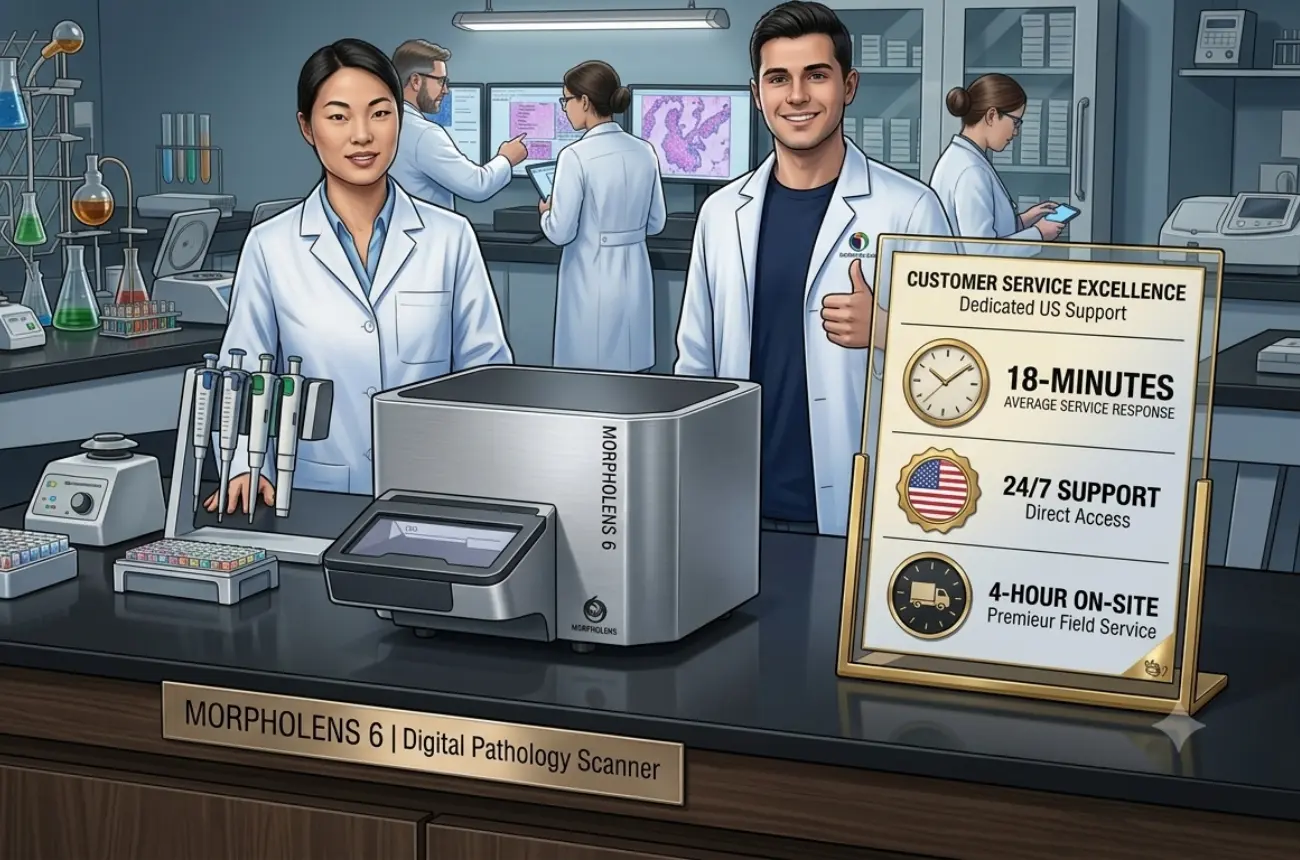
  • Vendor support and service — What are SLAs for maintenance and calibration?
  • Total cost of ownership — Factor in storage, IT, training, and service contracts, not just the hardware price

Future Trends

The WSI-telepathology ecosystem is evolving rapidly. Several developments will shape the next decade:

AI-assisted diagnosis — Computational pathology algorithms are being embedded directly into scanning workflows, flagging abnormalities, quantifying biomarkers, and triaging cases before a pathologist reviews them.

Federated learning — Labs are training AI models on distributed datasets without centralizing patient data, addressing privacy constraints while building powerful diagnostic tools.

Portable and compact scanners — The next frontier is bringing whole slide imaging capability to settings that could never support conventional lab infrastructure, point-of-care, field hospitals, and remote diagnostic centers.

Multimodal integration — Correlating WSI data with genomics, radiology, and clinical records is moving pathology toward truly integrated precision medicine.

Where Morphle Labs Fits In

Among the digital pathology companies building for this future, Morphle Labs stands out for its focus on high-throughput, high-fidelity scanning combined with intelligent workflow integration. Morphle's digital pathology scanner is engineered to deliver the resolution, speed, and connectivity that modern telepathology demands, whether you are running a busy diagnostic lab, supporting a multi-site clinical trial, or building an AI training dataset.

Morphle Labs understands that the value of whole slide imaging is only realized when the image gets to the right pathologist at the right time. That's why their platform is built with seamless remote access, LIS integration, and DICOM compliance at its core, not as an afterthought.

For labs assessing histology scanner options, Morphle Labs offers a solution designed to fit demanding diagnostic environments without compromising on image quality or operational simplicity.

The Bottom Line

Whole Slide Imaging and telepathology are not parallel technologies; they are a single, integrated capability. WSI provides the high-fidelity digital substrate; telepathology provides the distribution layer. Together, they dissolve the geographic constraints that have historically limited access to expert pathology.

The lab that invests in the right digital pathology scanner today is not just buying hardware; it is buying the ability to deliver expert-level diagnosis anywhere, collaborate instantly, and deploy AI diagnostics as the field matures.

Ready to See the Difference?

Talk to the Morphle Labs team today. Whether you are exploring your first digital pathology scanner or upgrading an existing workflow, our specialists will walk you through a personalized demo and help you identify the right configuration for your lab's volume, use case, and compliance requirements.

👉 Request a Demo with Morphle Labs; and take the first step toward a fully connected, AI-ready pathology workflow.

Learn more about digital pathology and various usecases

Read More
Contact Us
Afghanistan (+93)
Albania (+355)
Algeria (+213)
American Samoa (+1-684)
Andorra (+376)
Angola (+244)
Anguilla (+1-264)
Antarctica (+672)
Antigua and Barbuda (+1-268)
Argentina (+54)
Armenia (+374)
Aruba (+297)
Australia (+61)
Austria (+43)
Azerbaijan (+994)
Bahamas (+1-242)
Bahrain (+973)
Bangladesh (+880)
Barbados (+1-246)
Belarus (+375)
Belgium (+32)
Belize (+501)
Benin (+229)
Bermuda (+1-441)
Bhutan (+975)
Bolivia (+591)
Bosnia and Herzegovina (+387)
Botswana (+267)
Brazil (+55)
British Indian Ocean Territory (+246)
Brunei (+673)
Bulgaria (+359)
Burkina Faso (+226)
Burundi (+257)
Cambodia (+855)
Cameroon (+237)
Canada (+1)
Cape Verde (+238)
Cayman Islands (+1-345)
Central African Republic (+236)
Chad (+235)
Chile (+56)
China (+86)
Christmas Island (+53)
Cocos Islands (+61)
Colombia (+57)
Comoros (+269)
Congo (DRC) (+243)
Congo (Republic) (+242)
Cook Islands (+682)
Costa Rica (+506)
Cote D'Ivoire (+225)
Croatia (+385)
Cuba (+53)
Cyprus (+357)
Czech Republic (+420)
Denmark (+45)
Djibouti (+253)
Dominica (+1-767)
Dominican Republic (+1-809 and +1-829  )
East Timor (+670)
Ecuador (+593 )
Egypt (+20)
El Salvador (+503)
Equatorial Guinea (+240)
Eritrea (+291)
Estonia (+372)
Ethiopia (+251)
Falkland Islands (+500)
Faroe Islands (+298)
Fiji (+679)
Finland (+358)
France (+33)
French Guiana (+594)
French Polynesia (+689)
Gabon (+241)
Gambia (+220)
Georgia (+995)
Germany (+49)
Ghana (+233)
Gibraltar (+350)
Greece (+30)
Greenland (+299)
Grenada (+1-473)
Guadeloupe (+590)
Guam (+1-671)
Guatemala (+502)
Guinea (+224)
Guinea-Bissau (+245)
Guyana (+592)
Haiti (+509)
Honduras (+504)
Hong Kong (+852)
Hungary (+36)
Iceland (+354)
India (+91)
Indonesia (+62)
Iran (+98)
Iraq (+964)
Ireland (+353)
Israel (+972)
Italy (+39)
Jamaica (+1-876)
Japan (+81)
Jordan (+962)
Kazakhstan (+7)
Kenya (+254)
Kiribati (+686)
Kuwait (+965)
Kyrgyzstan (+996)
Laos (+856)
Latvia (+371)
Lebanon (+961)
Lesotho (+266)
Liberia (+231)
Libya (+218)
Liechtenstein (+423)
Lithuania (+370)
Luxembourg (+352)
Macau (+853)
Macedonia (+389)
Madagascar (+261)
Malawi (+265)
Malaysia (+60)
Maldives (+960)
Mali (+223)
Malta (+356)
Marshall Islands (+692)
Martinique (+596)
Mauritania (+222)
Mauritius (+230)
Mayotte (+269)
Mexico (+52)
Micronesia (+691)
Moldova (+373)
Monaco (+377)
Mongolia (+976)
Montserrat (+1-664)
Morocco (+212)
Mozambique (+258)
Myanmar (+95)
Namibia (+264)
Nauru (+674)
Nepal (+977)
Netherlands (+31)
Netherlands Antilles (+599)
New Caledonia (+687)
New Zealand (+64)
Nicaragua (+505)
Niger (+227)
Nigeria (+234)
Niue (+683)
Norfolk Island (+672)
Northern Mariana Islands (+1-670)
North Korea (+850)
Norway (+47)
Oman (+968)
Pakistan (+92)
Palau (+680)
Palestinian State (+970)
Panama (+507)
Papua New Guinea (+675)
Paraguay (+595)
Peru (+51)
Philippines (+63)
Poland (+48)
Portugal (+351)
Puerto Rico (+1-787 or +1-939)
Qatar (+974 )
Reunion (+262)
Romania (+40)
Russia (+7)
Rwanda (+250)
Saint Helena (+290)
Saint Kitts and Nevis (+1-869)
Saint Lucia (+1-758)
Saint Pierre and Miquelon (+508)
Saint Vincent and the Grenadines (+1-784)
Samoa (+685)
San Marino (+378)
Sao Tome and Principe (+239)
Saudi Arabia (+966)
Senegal (+221)
Serbia (+381)
Seychelles (+248)
Sierra Leone (+232)
Singapore (+65)
Slovakia (+421)
Slovenia (+386)
Solomon Islands (+677)
Somalia (+252)
South Africa (+27)
South Korea (+82)
South Sudan (+211)
Spain (+34)
Sri Lanka (+94)
Sudan (+249)
Suriname (+597)
Svalbard and Jan Mayen Islands (+47)
Swaziland (+268)
Sweden (+46)
Switzerland (+41)
Syria (+963)
Taiwan (+886)
Tajikistan (+992)
Tanzania (+255)
Thailand (+66)
Togo (+228)
Tokelau (+690)
Tonga (+676)
Trinidad and Tobago (+1-868)
Tunisia (+216)
Turkey (+90)
Turkmenistan (+993)
Turks and Caicos Islands (+1-649)
Tuvalu (+688)
Uganda (+256)
Ukraine (+380)
United Arab Emirates (+971)
United Kingdom (+44)
United States (+1)
Uruguay (+598)
Uzbekistan (+998)
Vanuatu (+678)
Vatican City State (+418)
Venezuela (+58)
Vietnam (+84)
Virgin Islands, British (+1-284)
Virgin Islands, United States (+1-340)
Wallis and Futuna Islands (+681)
Western Sahara (+212)
Yemen (+967)
Zambia (+260)
Zimbabwe (+263)