In pathology, a scanner going offline is not an inconvenience. It is a patient care issue. Slides queue up, turnaround times slip, pathologists lose remote access, and lab directors start making calls.
Before you bring any digital pathology system into your lab, you should ask the vendor one simple question: What exactly happens when something goes wrong?
This post answers that question for Morphle, directly and in specific terms, because vague promises about "dedicated support" do not hold up when you have 80 cases waiting to be scanned at 7 AM on a Tuesday.
Morphle operates 33 field-based personnel across the United States, covering technical support, installation, field service, and on-site customer success. This is in addition to remote support engineers and management; 33 is the count of people physically on the ground in the US, able to reach you.
For context: many digital pathology vendors of comparable or larger scanner volume run leaner US teams and rely heavily on international remote support. Morphle made the decision early to build a substantial US-based field presence, because digital pathology workflows require hands that can physically be in your lab when it matters.
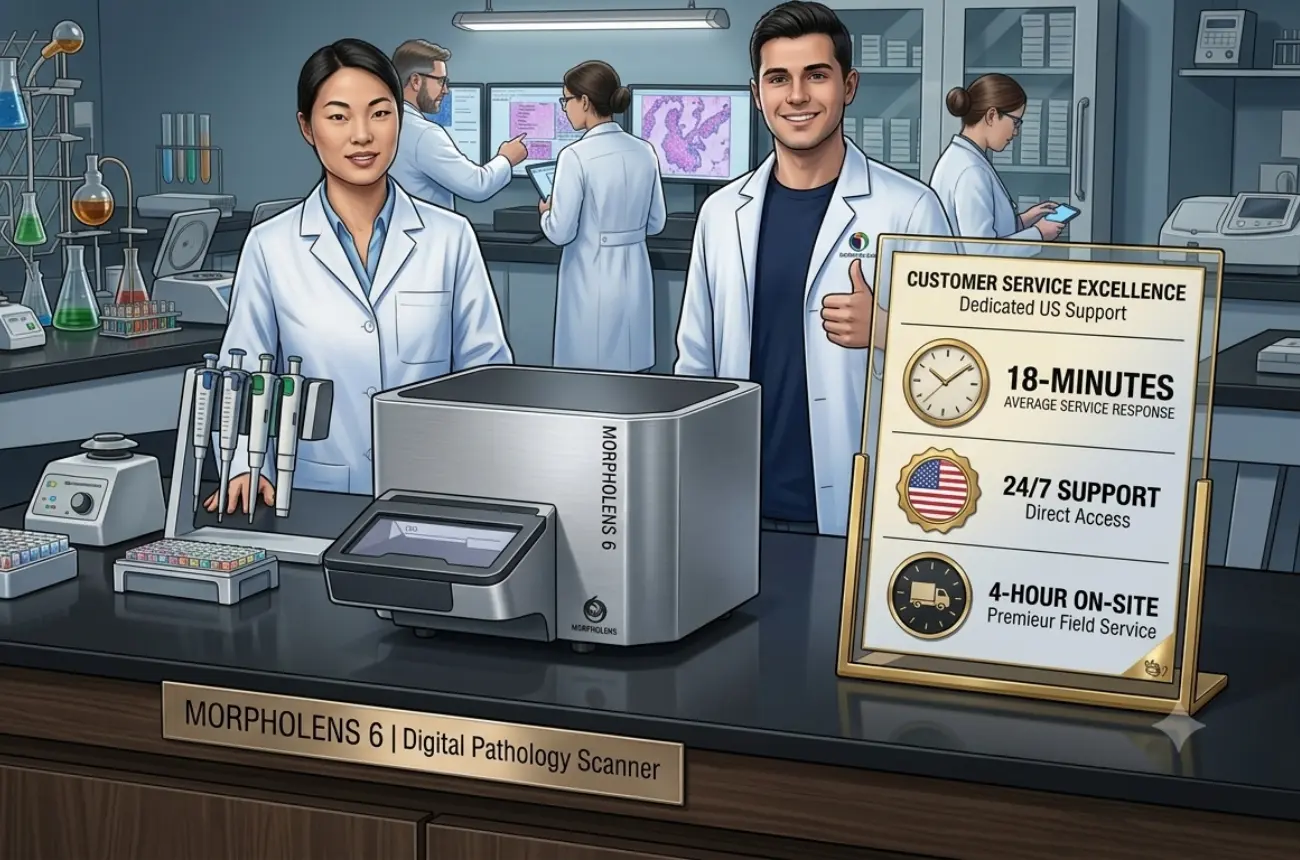
Morphle support operates 24 hours a day, 7 days a week for its customers. There is no "business hours only" tier for critical issues. If your scanner goes down at 11 PM before a high-volume day, you are not waiting until 8 AM for a callback.
This matters particularly for labs that scan overnight, labs in time zones that create gaps with India-based support teams, and labs where pathologists depend on remote access to slides from home.
When a support ticket is opened, Morphle's current average first-response time is 18 minutes. This is an average across all ticket types, not a best-case metric, not a service level commitment on paper that rarely gets met.
For comparison: many enterprise software vendors quote 4-hour first-response SLAs for critical issues. For a device that sits in the middle of a clinical workflow, 18 minutes is the standard Morphle holds itself to.
For issues that cannot be resolved remotely, Morphle dispatches field service personnel. Response time depends on the service agreement tier:
Standard service agreement: On-site response within 24 hours of issue confirmation.
Premium service agreement: On-site response within 4 hours.
Both tiers include access to 24x7 phone and remote support. The difference is the guaranteed physical response window for hardware issues that require hands-on intervention.
If your lab operates in a high-volume or high-dependency environment, a reference lab, a multi-site tele-pathology network, or an academic center with resident training workflows, the response time tier of your service agreement is one of the most important commercial decisions you will make alongside the scanner purchase.
Some service agreements include loaner scanner placement. If your scanner requires depot repair or an extended on-site intervention, a loaner unit can be placed in your lab to maintain workflow continuity while your primary scanner is serviced.
Loaner availability is agreed at the time of the service contract and depends on your agreement tier and geography. If workflow continuity during downtime is a hard requirement for your lab, and for most clinical labs, it should be; this is a term worth negotiating explicitly at purchase.
Morphle's support escalation is structured, not ad hoc. When a critical issue is not resolved within expected time frames, it moves up a defined chain:
Level 1 — First Response (0–18 min avg): Remote support engineer. Covers software issues, connectivity, scan quality, configuration, and basic hardware diagnostics.
Level 2 — Field Dispatch: On-site field engineer. Triggered when remote resolution is not achievable or when hardware intervention is required. Response within 4–24 hours, depending on agreement.
Level 3 — Engineering Escalation: Morphle's product and engineering team. For issues involving scanner firmware, software bugs, or hardware failures requiring root cause analysis and a permanent fix.
Level 4 — Executive Escalation: For a scanner that is down and actively impacting patient reporting, not just lab productivity, but clinical workflow, the escalation goes to Sunnel Daniel, COO. Directly reachable. This is not a symbolic gesture; it is the accountability structure Morphle's leadership team has committed to.
Morphle offers formal service contracts separate from the scanner purchase, with tiered terms covering:
Service contract terms should be reviewed in detail during procurement, not after installation. The right contract depends on your case volume, number of scanners, geographic location relative to Morphle's field team, and your lab's tolerance for downtime.
If you are running a single-scanner lab with moderate volume, a standard contract may be appropriate. If you are operating a multi-site tele-pathology network or a high-volume reference lab where scanner uptime is directly tied to TAT commitments with hospital clients, a premium contract with loaner placement is worth the investment.
Before signing a service agreement with any scanner vendor, get clear answers to these questions:
The answers separate vendors who have built for clinical environments from those who have not.
Morphle operates 33 field-based personnel across the US with 24x7 support, 18-minute average first response, and on-site response commitments of 4–24 hours depending on service agreement tier. To discuss service agreement options or request a quote, contact us at sales@morphlelabs.com or call +1 (628) 213-7227.


.webp)
.webp)
.webp)
.webp)
.webp)
.webp)