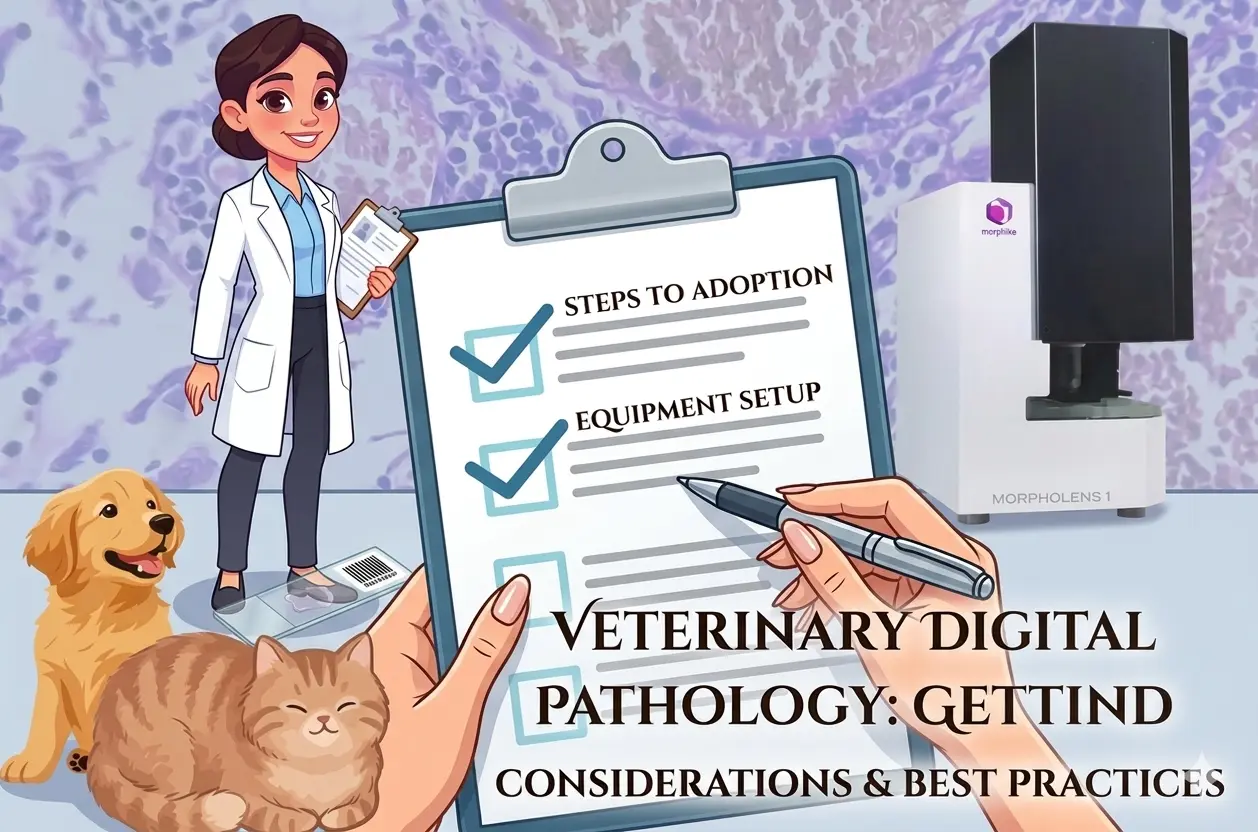
Veterinary Digital Pathology: Getting Started

A comprehensive guide to veterinary digital pathology, covering workflows, key technical considerations, benefits, limitations, and how to choose the right scanner for your lab.
4 mins

Veterinary Digital Pathology: Getting Started

TL;DR: 

Veterinary diagnostic labs are rapidly embracing digital pathology, and for good reason. A modern digital pathology scanner eliminates geographic barriers, accelerates diagnoses, and opens the door to AI-powered analysis. This guide walks you through everything you need to know before leaping.

What You'll Learn

  • What veterinary digital pathology is and why it matters
  • How the digitization workflow works in practice
  • Key technical factors to evaluate before buying
  • Benefits, limitations, and what to watch for
  • A practical buying checklist
  • Where the field is heading; and how to stay ahead

What Is Veterinary Digital Pathology?

Veterinary digital pathology is the process of converting traditional glass histology slides into high-resolution digital images, called Whole Slide Images (WSIs), that can be stored, shared, and analyzed on a computer screen or cloud platform.

At its core, the process relies on a digital pathology scanner: a precision imaging instrument that captures an entire glass slide at magnifications equivalent to or exceeding a conventional optical microscope. The resulting file is navigable at any zoom level, just like a physical slide under a lens, but without the physical slide ever needing to leave the lab.

Once niche, digital pathology has rapidly evolved in veterinary medicine, with clinical pathology specimens now being routinely digitized alongside histology samples.

The Digitization Workflow

Understanding the end-to-end process helps set realistic expectations:

Sample collection → Preparation (fixation, embedding, microtomy, staining, mounting) → High-resolution scanning → Server upload → Remote review by the pathologist → Report generation

The digital pathology scanner sits at the critical hand-off point between the wet lab and the diagnostic workstation. Scan quality, throughput, and file format compatibility at this stage determine the success of everything downstream; from AI-assisted analysis to tele-consultation.

Technical Factors to Evaluate

Before committing to any system, evaluate these parameters carefully:

Resolution and magnification — Most diagnostic applications require 20× or 40× equivalent scanning. Cytology specimens often demand higher magnification and Z-stack (multi-focal plane) capabilities, which not all scanners support.

Throughput — High-volume diagnostic labs need automated batch scanning. An automated microscope slide scanner with multi-slide loading reduces technician time and standardizes image quality across runs.

File format and interoperability — Ensure your scanner outputs open or widely supported formats (SVS, NDPI, MRXS). Proprietary formats can create lock-in and complicate long-term data archiving.

Integration with LIS/LIMS — Seamless connection with your Laboratory Information System is non-negotiable for workflow efficiency and traceability.

Storage and viewing infrastructure — WSI files are large (1–4 GB per slide is common). Plan your server or cloud storage capacity before day one.

Benefits vs. Limitations

Benefits:

  • Remote diagnosis and specialist teleconsultation without shipping fragile glass slides
  • Consistent, reproducible image quality across cases
  • AI and machine learning integration for cell counting, mitotic figure detection, and tumor grading
  • Archival storage that doesn't degrade over time
  • Teaching and training use cases ; whole slide archives can be shared with students and residents instantly

Limitations:

  • High upfront capital cost of scanning hardware (see buying guide below)
  • Large file sizes demand robust IT infrastructure
  • Validation workflows are required before primary diagnosis can be performed digitally
  • Not all scanners handle every specimen type equally (cytology, bone marrow, and exotic animal samples require special attention)
  • Regulatory frameworks for veterinary primary digital diagnosis are still maturing in many regions

Applications in Veterinary Practice

The use cases for digital pathology in veterinary settings span a wide spectrum:

  • Diagnostic laboratories — primary and peer-review diagnosis of biopsy and necropsy material
  • Oncology — tumor grading, mitotic index counting, and biomarker quantification
  • Toxicology studies — GLP-compliant nonclinical histopathology supported by digital workflows
  • Exotic and zoo animal medicine — remote access to specialist opinions for rare species
  • Veterinary education — interactive slide libraries for pathology teaching
  • Research — canine skin tumor classification, AI model training, and comparative pathology studies

Buying Guide: What to Check Before You Purchase

Use this checklist when evaluating vendors:

  • Does the scanner support the magnification levels your cases require (20×, 40×, or Z-stack)?
  • What is the slide throughput per hour? Does it match your lab volume?
  • Is it a true Slide Scanner Histology system with validated focus across varied tissue types?
  • What file formats does it output, and are they compatible with your viewing and analysis software?
  • Does the vendor offer a validated integration pathway with your LIS/LIMS?
  • What is the total cost of ownership, including Digital Pathology Scanner price, maintenance contracts, and storage infrastructure?
  • Is the vendor able to provide application support for veterinary-specific use cases?
  • Does the system support Whole Slide Scanning with automated quality control and rescan flagging?
  • What are the warranty and service response time commitments?

Future Trends

The field is moving fast. Key directions to watch:

AI-powered analysis — Machine learning models trained on veterinary WSI datasets are already demonstrating diagnostic accuracy comparable to experienced pathologists for specific tumor types. This will become routine.

Cloud-native pathology — Centralized scan-and-read models will allow regional diagnostic hubs to serve clinics across wide geographies without any glass slide logistics.

Multimodal integration — Combining digital morphology with genomics, proteomics, and clinical metadata will redefine prognostic scoring in veterinary oncology.

Point-of-care scanning — Smaller-footprint Histology Scanners are making it feasible to deploy scanning capability outside the central lab — at specialty clinics, research institutes, and even in the field.

Where Morphle Fits In

Navigating the landscape of Digital Pathology Companies requires cutting through the noise. Morphle Labs is building precision scanning hardware with a clear focus on accessibility and performance — making whole slide imaging practical not just for large academic institutions but for mid-sized diagnostic labs and veterinary practices ready to modernize their workflows.

Morphle's digital pathology solutions are designed with interoperability and ease of integration in mind, so your team spends less time managing IT complexity and more time delivering diagnostic value.

Ready to Digitize Your Lab?

The transition to digital pathology is no longer a question of if ; it's a question of when and with whom.

Whether you're scanning your first batch of histology slides or scaling up to a multi-site digital diagnostic network, getting the right digital pathology scanner from the right partner makes all the difference.

Explore Morphle Labs' veterinary pathology solutions today, and take the first step toward faster diagnoses, smarter workflows, and future-ready laboratory infrastructure.

Book a Demo with Morphle Labs →

Learn more about digital pathology and various usecases

Read More
Contact Us
Afghanistan (+93)
Albania (+355)
Algeria (+213)
American Samoa (+1-684)
Andorra (+376)
Angola (+244)
Anguilla (+1-264)
Antarctica (+672)
Antigua and Barbuda (+1-268)
Argentina (+54)
Armenia (+374)
Aruba (+297)
Australia (+61)
Austria (+43)
Azerbaijan (+994)
Bahamas (+1-242)
Bahrain (+973)
Bangladesh (+880)
Barbados (+1-246)
Belarus (+375)
Belgium (+32)
Belize (+501)
Benin (+229)
Bermuda (+1-441)
Bhutan (+975)
Bolivia (+591)
Bosnia and Herzegovina (+387)
Botswana (+267)
Brazil (+55)
British Indian Ocean Territory (+246)
Brunei (+673)
Bulgaria (+359)
Burkina Faso (+226)
Burundi (+257)
Cambodia (+855)
Cameroon (+237)
Canada (+1)
Cape Verde (+238)
Cayman Islands (+1-345)
Central African Republic (+236)
Chad (+235)
Chile (+56)
China (+86)
Christmas Island (+53)
Cocos Islands (+61)
Colombia (+57)
Comoros (+269)
Congo (DRC) (+243)
Congo (Republic) (+242)
Cook Islands (+682)
Costa Rica (+506)
Cote D'Ivoire (+225)
Croatia (+385)
Cuba (+53)
Cyprus (+357)
Czech Republic (+420)
Denmark (+45)
Djibouti (+253)
Dominica (+1-767)
Dominican Republic (+1-809 and +1-829  )
East Timor (+670)
Ecuador (+593 )
Egypt (+20)
El Salvador (+503)
Equatorial Guinea (+240)
Eritrea (+291)
Estonia (+372)
Ethiopia (+251)
Falkland Islands (+500)
Faroe Islands (+298)
Fiji (+679)
Finland (+358)
France (+33)
French Guiana (+594)
French Polynesia (+689)
Gabon (+241)
Gambia (+220)
Georgia (+995)
Germany (+49)
Ghana (+233)
Gibraltar (+350)
Greece (+30)
Greenland (+299)
Grenada (+1-473)
Guadeloupe (+590)
Guam (+1-671)
Guatemala (+502)
Guinea (+224)
Guinea-Bissau (+245)
Guyana (+592)
Haiti (+509)
Honduras (+504)
Hong Kong (+852)
Hungary (+36)
Iceland (+354)
India (+91)
Indonesia (+62)
Iran (+98)
Iraq (+964)
Ireland (+353)
Israel (+972)
Italy (+39)
Jamaica (+1-876)
Japan (+81)
Jordan (+962)
Kazakhstan (+7)
Kenya (+254)
Kiribati (+686)
Kuwait (+965)
Kyrgyzstan (+996)
Laos (+856)
Latvia (+371)
Lebanon (+961)
Lesotho (+266)
Liberia (+231)
Libya (+218)
Liechtenstein (+423)
Lithuania (+370)
Luxembourg (+352)
Macau (+853)
Macedonia (+389)
Madagascar (+261)
Malawi (+265)
Malaysia (+60)
Maldives (+960)
Mali (+223)
Malta (+356)
Marshall Islands (+692)
Martinique (+596)
Mauritania (+222)
Mauritius (+230)
Mayotte (+269)
Mexico (+52)
Micronesia (+691)
Moldova (+373)
Monaco (+377)
Mongolia (+976)
Montserrat (+1-664)
Morocco (+212)
Mozambique (+258)
Myanmar (+95)
Namibia (+264)
Nauru (+674)
Nepal (+977)
Netherlands (+31)
Netherlands Antilles (+599)
New Caledonia (+687)
New Zealand (+64)
Nicaragua (+505)
Niger (+227)
Nigeria (+234)
Niue (+683)
Norfolk Island (+672)
Northern Mariana Islands (+1-670)
North Korea (+850)
Norway (+47)
Oman (+968)
Pakistan (+92)
Palau (+680)
Palestinian State (+970)
Panama (+507)
Papua New Guinea (+675)
Paraguay (+595)
Peru (+51)
Philippines (+63)
Poland (+48)
Portugal (+351)
Puerto Rico (+1-787 or +1-939)
Qatar (+974 )
Reunion (+262)
Romania (+40)
Russia (+7)
Rwanda (+250)
Saint Helena (+290)
Saint Kitts and Nevis (+1-869)
Saint Lucia (+1-758)
Saint Pierre and Miquelon (+508)
Saint Vincent and the Grenadines (+1-784)
Samoa (+685)
San Marino (+378)
Sao Tome and Principe (+239)
Saudi Arabia (+966)
Senegal (+221)
Serbia (+381)
Seychelles (+248)
Sierra Leone (+232)
Singapore (+65)
Slovakia (+421)
Slovenia (+386)
Solomon Islands (+677)
Somalia (+252)
South Africa (+27)
South Korea (+82)
South Sudan (+211)
Spain (+34)
Sri Lanka (+94)
Sudan (+249)
Suriname (+597)
Svalbard and Jan Mayen Islands (+47)
Swaziland (+268)
Sweden (+46)
Switzerland (+41)
Syria (+963)
Taiwan (+886)
Tajikistan (+992)
Tanzania (+255)
Thailand (+66)
Togo (+228)
Tokelau (+690)
Tonga (+676)
Trinidad and Tobago (+1-868)
Tunisia (+216)
Turkey (+90)
Turkmenistan (+993)
Turks and Caicos Islands (+1-649)
Tuvalu (+688)
Uganda (+256)
Ukraine (+380)
United Arab Emirates (+971)
United Kingdom (+44)
United States (+1)
Uruguay (+598)
Uzbekistan (+998)
Vanuatu (+678)
Vatican City State (+418)
Venezuela (+58)
Vietnam (+84)
Virgin Islands, British (+1-284)
Virgin Islands, United States (+1-340)
Wallis and Futuna Islands (+681)
Western Sahara (+212)
Yemen (+967)
Zambia (+260)
Zimbabwe (+263)