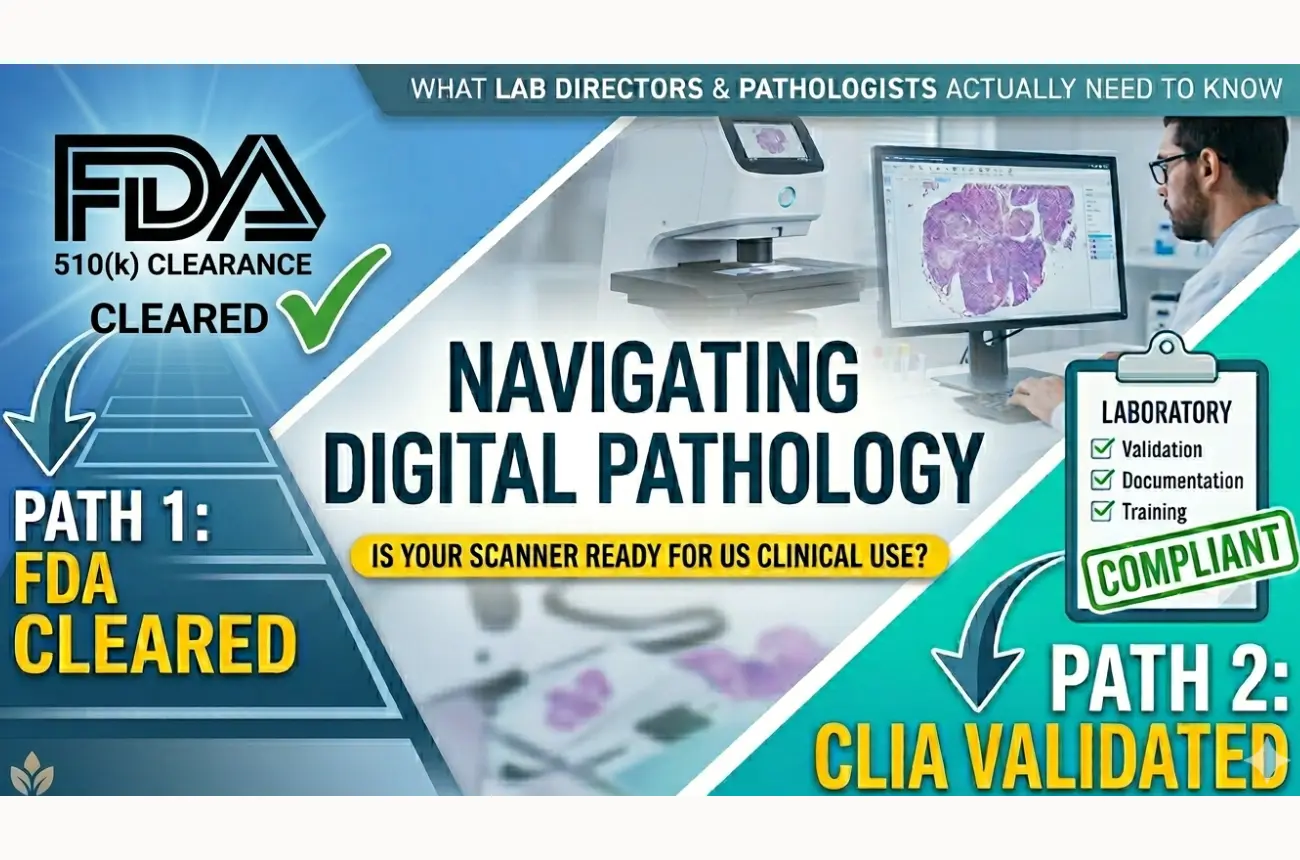
Digital pathology adoption in the US is accelerating. Labs are scanning more slides, enabling remote reporting, and building the infrastructure for AI-assisted workflows. Alongside this growth, a persistent question comes up in procurement conversations: Is this scanner FDA cleared?
It is a fair question. The answer, however, is more nuanced than most vendors let on, and understanding the actual regulatory landscape will help you make a better decision for your lab, regardless of which scanner you choose.
The FDA classifies whole slide imaging (WSI) systems under its Software as a Medical Device (SaMD) framework. A scanner intended for primary diagnosis, meaning a pathologist would render a clinical diagnosis directly from the digital image without reviewing the physical glass slide, is considered a Class II medical device requiring 510(k) clearance.
This is a high bar, and deliberately so. The FDA requires clinical validation data demonstrating that diagnostic accuracy on digital images is equivalent to glass slide review. Studies typically involve large case sets, multiple pathologists, and washout periods. The process takes years and carries a high cost.
As a result, the number of FDA-cleared WSI systems for primary diagnosis in the US remains small.
As of mid-2025, the FDA has cleared a limited set of WSI scanners for primary diagnostic use. These include the Philips IntelliSite Pathology Solution (cleared in 2017, the first in the US), the Leica Aperio GT 450 DX (initially cleared in 2019, with expanded DICOM clearance in 2024), and the Hamamatsu NanoZoomer S360MD.
What is notable, and less widely understood, is that FDA clearance is product-specific, not brand-wide.
It is worth noting that several recently launched high-throughput scanners from established vendors, including some positioned as next-generation flagships, also carry 'For Research Use Only' labeling and do not hold FDA clearance for primary diagnosis.
This matters because buyers and procurement teams often assume that regulatory standing transfers across a vendor's product line. It does not. FDA clearance is granted to a specific device with a specific intended use, validated through a specific study. A newer, faster, or more capable scanner from the same manufacturer starts from zero unless it goes through its own 510(k) process.
Scanners labeled "for research use only" (RUO) are not clinical non-starters. In practice, the vast majority of WSI scanners operating in US pathology labs today, including those at major academic medical centers and reference labs, are RUO devices.
What RUO means, regulatory speaking, is that the manufacturer has not submitted and received FDA clearance for the device as a standalone primary diagnostic tool. It does not mean the scanner cannot be used in clinical settings, and it does not mean scans from the device cannot be used for clinical purposes.
What it does mean is that the laboratory assumes responsibility for validating the system for its intended clinical use. This is where CLIA comes in.
The Clinical Laboratory Improvement Amendments (CLIA) framework governs laboratory testing in the US. Under CLIA, a laboratory director has the authority, and the responsibility, to validate non-cleared laboratory-developed tests and methodologies, including digital pathology workflows using RUO scanners.
This is not a workaround or a gray area. It is the established, recognized pathway that laboratories across the US use to deploy digital pathology clinically. The College of American Pathologists (CAP) provides specific guidance on how laboratories should conduct this validation, including concordance studies comparing digital diagnoses to glass slide diagnoses across representative case types and stain profiles.
A well-designed CLIA validation study typically covers:
When completed and documented properly, CLIA validation establishes the laboratory's confidence in its digital workflow and satisfies CAP accreditation requirements. Many independent AP labs, reference laboratories, and hospital-based labs across the US are currently operating validated digital pathology workflows using RUO scanners — including Morphle.
Not entirely. Even when using an FDA-cleared scanner, CAP-accredited laboratories are still expected to conduct their own institutional validation before deploying the system for clinical use. The FDA clearance covers the manufacturer's claim of equivalence; CLIA validation covers the laboratory's specific case mix, specimen types, staining protocols, and pathologist workflow.
FDA clearance and CLIA validation are complementary but distinct. Clearance de-risks the regulatory conversation; validation de-risks the clinical workflow.
FDA clearance activity in digital pathology is increasing. Cleared products are no longer limited to a single vendor. Software platforms are obtaining their own clearances, sometimes tied to specific scanners, creating cleared scanner-plus-viewer combinations that offer a fully regulated end-to-end pathway for labs that require it.
At Morphle, we are pursuing FDA clearance for our Morpholens 400, our high-throughput flagship designed to scan 100 slides per hour. We believe FDA clearance matters, and we are investing in the process. In the meantime, our current installed base of labs in the US is operating under CLIA-validated workflows with full confidence in their clinical outcomes.
The goal of this piece is not to dismiss FDA clearance; it is a meaningful milestone and one we are actively working toward. The goal is to ensure that lab directors and pathologists understand the actual regulatory landscape clearly, so procurement decisions are based on facts rather than assumptions about which vendors and products carry what regulatory standing.
If you are evaluating WSI scanners for US clinical use, here are the questions worth asking every vendor:
The answers will tell you a great deal, not just about the product, but about how well the vendor understands the real workflow needs of a US clinical lab.
Morphle is a digital pathology company building WSI scanners and workflow software for AP labs globally. With hundreds of scanners deployed across the US, Morphle supports CLIA validation for US labs and is pursuing FDA clearance for its Morpholens 400 high-throughput scanner. For questions about digital pathology regulatory pathways, contact us at sales@morphlelabs.com.


.webp)
.webp)
.webp)
.webp)
.webp)
.webp)