Digital pathology automation delivers measurable staffing efficiencies through workflow optimization rather than workforce reduction. Academic medical centers report 13% pathologist productivity gains, equivalent to 1.5 additional cases per day, while technical staff savings average 0.48 FTE per 10,000 annual cases. Large laboratories document over 19 working hours saved daily through automated case assembly and streamlined workflows, translating to redeployed capacity worth hundreds of thousands annually rather than immediate headcount cuts.
This analysis examines evidence-based staffing impact data from digital pathology scanner implementations across diverse laboratory settings. You'll discover realistic productivity metrics, understand where automation creates genuine efficiency versus requiring new roles, evaluate implementation costs against staffing benefits, and learn how leading laboratories quantify return on investment for digital transformation initiatives.
The staffing equation for digital pathology proves more nuanced than simple headcount reduction. Automation redistributes work rather than eliminating it entirely. While certain manual tasks disappear, physical slide sorting, archive retrieval, and case delivery between pathologists, new responsibilities emerge around scanner operation, image quality verification, digital workflow management, and IT infrastructure maintenance.
Successful implementations treat automation as a productivity multiplier, enabling existing staff to handle increased volumes, reduce turnaround times, and access subspecialty expertise more efficiently. Laboratories approaching digital transformation, expecting immediate workforce cuts, typically discover that the investment case depends more on throughput expansion and quality improvements than personnel elimination.
Academic research provides concrete metrics on pathologist productivity improvements from whole slide scanning adoption. A comprehensive time and motion study documented 13% overall time savings in pathologists' workdays; approximately 43 minutes per eight-hour shift, through automating case assembly, queries, retrieval, and delivery processes. For a pathologist signing out 3,300 cases annually, this translates to capacity for roughly 1.5 additional cases per workday.
The productivity mechanism operates through multiple channels. Digital case organization eliminates time spent locating slides, matching cases, or waiting for physical delivery. Simultaneous viewing of previous biopsies, special stains, and current specimens accelerates comparison tasks that previously required assembling multiple slide sets. Remote access enables flexible work scheduling that maximizes productive hours rather than constraining diagnosis to on-site availability.
One large integrated health organization calculated potential pathologist FTE gains based on 50% reduction in second-opinion consult requests from generalists to sub-specialists. The mechanism involves increased generalist confidence when easily accessing previous sub-specialist interpretations, digital reference libraries, and AI-assisted pattern recognition tools. European laboratories implementing digital pathology reported workforce efficiency improvements enabling them to handle growing volumes without adding pathologist FTEs, representing time reallocation to other laboratory tasks rather than position elimination.
Histotechnologist staffing exhibits different dynamics. The most comprehensive laboratory efficiency study identified 2.63 FTE savings for a facility processing 220 daily cases; approximately 0.48 FTE per 10,000 annual cases. These gains derive primarily from laboratory consolidation opportunities enabled by automated microscope slide scanners, where economies of scale concentrate technical work from dispersed laboratories into centralized facilities.
However, digital pathology creates new technical roles. Memorial Sloan Kettering Cancer Center documents requiring approximately 1 FTE per 3-4 whole slide scanner devices to manage scanning workflows, ensure quality, and perform post-scan review. Image quality verification represents a significant staffing expense, as successful scanning demands monitoring for focus issues, tissue detection accuracy, and artifact prevention. A 93% decrease in glass slide archive requests allowed redistributing 3 archive FTEs into digital pathology operations workflow rather than creating a net reduction.
Scanner validation and regulatory compliance require dedicated effort; approximately 0.5 FTE from digital scan teams plus 30 hours of pathologist time minimum. Periodic scanner testing, preventive maintenance scheduling, and training module development demand planning for additional staff time are often underestimated in initial business cases.
Detailed workflow modeling reveals where automation delivers maximum impact. A large regional pathology laboratory in the Netherlands quantified time savings across critical workflows:
Routine diagnosis workflows achieved the highest absolute savings through eliminating physical slide handling, transport, and matching tasks. Digital systems automatically assemble complete case information: previous slides, radiology images, and laboratory results; accessible instantly rather than requiring manual gathering.
Multidisciplinary meeting preparation traditionally consumed substantial time sorting slides, verifying completeness, and physically transporting them to meeting locations. Digital systems enable simultaneous case review by all participants regardless of location, with annotation: approximately 0.5 FTE from digital scan teams, plus a minimum of 30 hours of pathologist time and discussions captured directly on images.
External revision requests no longer require physical slide shipping, tracking, and return. Digital transmission occurs within hours rather than days or weeks, while original slides remain securely archived.
Ancillary test ordering decreased significantly when pathologists accessed previous slides digitally. One academic center documented an immunohistochemistry test reduction from 52% before whole slide scanner implementation to 21% after deployment, as readily accessible previous stains enabled diagnosis without confirmatory testing.
Digital pathology investments create new IT support needs that offset some technical staff savings. Organizations must evaluate existing IT resources, bandwidth capacity, and expertise before implementation. Complex or large-scale deployments typically require additional IT FTEs for infrastructure management, troubleshooting, and optimization.
Memorial Sloan Kettering's digital operations estimate infrastructure staffing beyond scanner technicians, though exact requirements depend on deployment scale and integration complexity. Organizations should assess IT support needs, including network architecture requirements, storage infrastructure management, laboratory information system integration, cyber security protocols, and disaster recovery capabilities.
Change management staffing represents another frequently underestimated requirement. Successfully transitioning pathologists from manual workflows to digital systems requires dedicated personnel who train users, address concerns, demonstrate benefits, and advocate for adoption. Culture transformation proves as critical as technology deployment; organizations spending significant resources on digital pathology companies' solutions see limited return if pathologists resist adoption due to inadequate change management support.
A five-year financial projection for a large integrated health organization with 219,000 annual cases estimated $18 million total savings; approximately $85 per case, including increased diagnostic accuracy benefits. However, this comprehensive figure encompasses multiple value streams beyond pure staffing reduction: treatment cost avoidance through improved diagnostic precision, reduced slide archival costs, decreased courier expenses, and productivity gains.
When isolating staffing components specifically, European laboratory analysis projects technician and pathologist FTE reductions translate into annual savings ranging from €0 to €107,000, totaling €372,000 over seven years. The variance reflects institutional differences in baseline efficiency, case volumes, and redeployment opportunities. Notably, these figures represent workforce reallocation capacity rather than guaranteed headcount elimination.
Initial digital pathology scanner price considerations must balance against these long-term efficiency gains. While upfront capital investment appears substantial, an extended scanner lifespan, typically 7-10 years with proper maintenance, distributes costs across many years of productivity benefits. Organizations should calculate cost per case over equipment lifetime rather than focusing exclusively on acquisition expense.
Automation delivers value through mechanisms difficult to quantify in traditional staffing terms. Pathologist time savings of 13% may not justify reducing headcount, but enable handling volume growth without proportional staffing increases; critical as pathology faces projected deficits exceeding 5,700 pathologists by 2030.
Reduced reliance on optical microscopy generates savings through decreased microscope replacement and maintenance costs. Slide storage expense reduction proves substantial in metropolitan areas where real estate commands premium rates. Quality improvements, reduced errors, faster turnaround times, enhanced diagnostic precision; create value extending beyond laboratory budgets. Earlier accurate diagnosis prevents costly treatment delays and inappropriate interventions, generating system-wide savings far exceeding pathology department efficiencies.
When evaluating slide scanner histology systems, laboratories should prioritize automation features that directly impact staffing requirements. Automated tissue detection eliminates manual scan area selection, reducing operator involvement and accelerating batch processing. Barcode reading and laboratory information system integration enable automatic case routing without manual intervention.
Scan speed determines throughput per scanner and, consequently, staffing density required. Platforms completing standard specimens within 90 seconds require fewer devices for equivalent daily volume compared with systems requiring 3-5 minutes per slide, directly affecting the FTE-to-scanner ratio and capital investment required.
Image quality consistency minimizes rescan rates that consume technician time without adding value. Laboratories report rescan rates varying from 1-2% with optimized systems to 5-8% with problematic platforms; seemingly small differences translating to substantial cumulative time waste across thousands of annual cases.
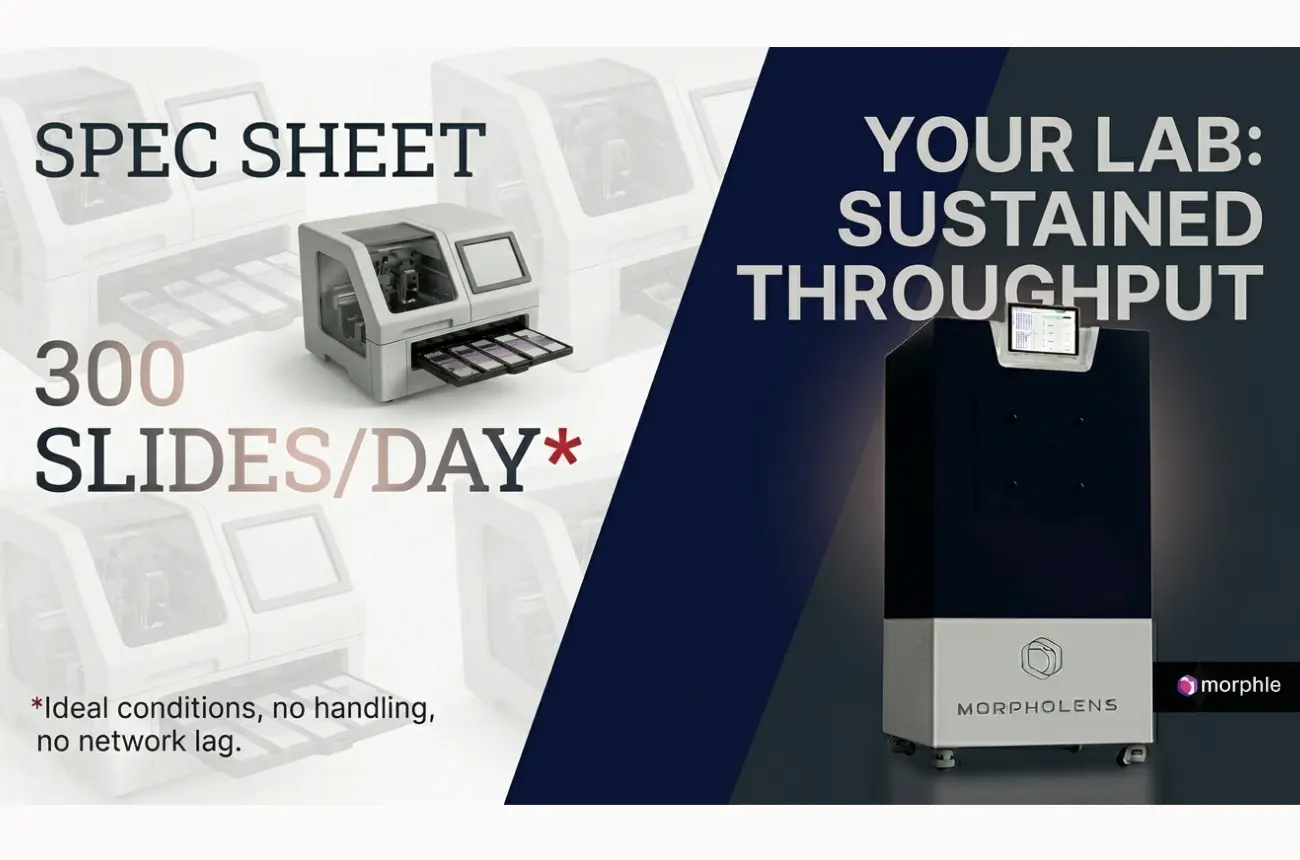
For laboratories seeking efficient entry into digital pathology, solutions like Morphle Labs deliver productivity-focused features at accessible price points. Their platforms achieve diagnostic-grade imaging at 0.22 microns per pixel with scan times averaging 90 seconds, depending on focus requirements; balancing speed and quality to optimize staffing efficiency. Compact file formats reduce storage costs by approximately 75% decrease IT infrastructure staffing demands for archive management.
Multiple scanner configurations from single-slide research systems through 240-slide high-throughput platforms enable laboratories to match capacity precisely to volume, avoiding over-investment in unnecessary throughput or under-staffing due to scanner bottlenecks. Consistent imaging standards across the product line simplify training and reduce the specialized expertise required for scanner operation.
Organizations should approach digital pathology staffing projections with grounded expectations. Immediate headcount reductions rarely materialize as anticipated. Instead, successful implementations redeploy staff capacity toward higher-value activities: complex case analysis, quality initiatives, sub-specialty development, and volume growth accommodation.
Three-to-five-year horizons prove more realistic for achieving projected staffing efficiencies as workflows mature, staff develop proficiency, and volume growth absorbs capacity. Early implementation phases may require net staffing increases to manage dual workflows during transition, validate systems, and train personnel.
The strongest business cases emphasize capacity creation over cost-cutting. Digital pathology enables laboratories to handle 15-30% volume growth without proportional staffing increases, provide subspecialty consultation access regardless of geography, reduce turnaround times, improve patient care, and prepare infrastructure for AI integration that will define pathology's future.
Staffing savings from digital pathology automation are real but require a realistic assessment. Organizations documenting 13% pathologist productivity gains, 0.48 FTE technical savings per 10,000 cases, and 19 hours daily time recapture demonstrate automation's power to transform laboratory operations. Success demands viewing automation as a productivity multiplier, enabling better work rather than a mechanism for workforce reduction.
Contact Morphle Labs for a comprehensive consultation on implementing pathology slide scanner solutions that maximize productivity gains while minimizing operational complexity.


.webp)
.webp)
.webp)
.webp)
.webp)
.webp)