Thick tissue sections and uneven specimens present one of the biggest challenges in digital pathology. Standard single-plane scanning often fails to capture diagnostically relevant details, making Z-stacking essential. Choosing the right Digital pathology scanner; with precise focus control, reliable Z-stacking, and consistent image quality; is critical for labs handling thick sections, cytology, and complex histology workflows.
Digital Pathology Scanner
A Digital pathology scanner converts glass slides into high-resolution digital images for viewing, analysis, and storage. Scanner performance directly impacts image clarity, especially for non-uniform samples.
Thick Sections
Tissue sections that exceed standard thickness (typically >4–5 µm), often seen in cytology, bone marrow, frozen sections, or poorly flattened specimens.
Z-Stacking
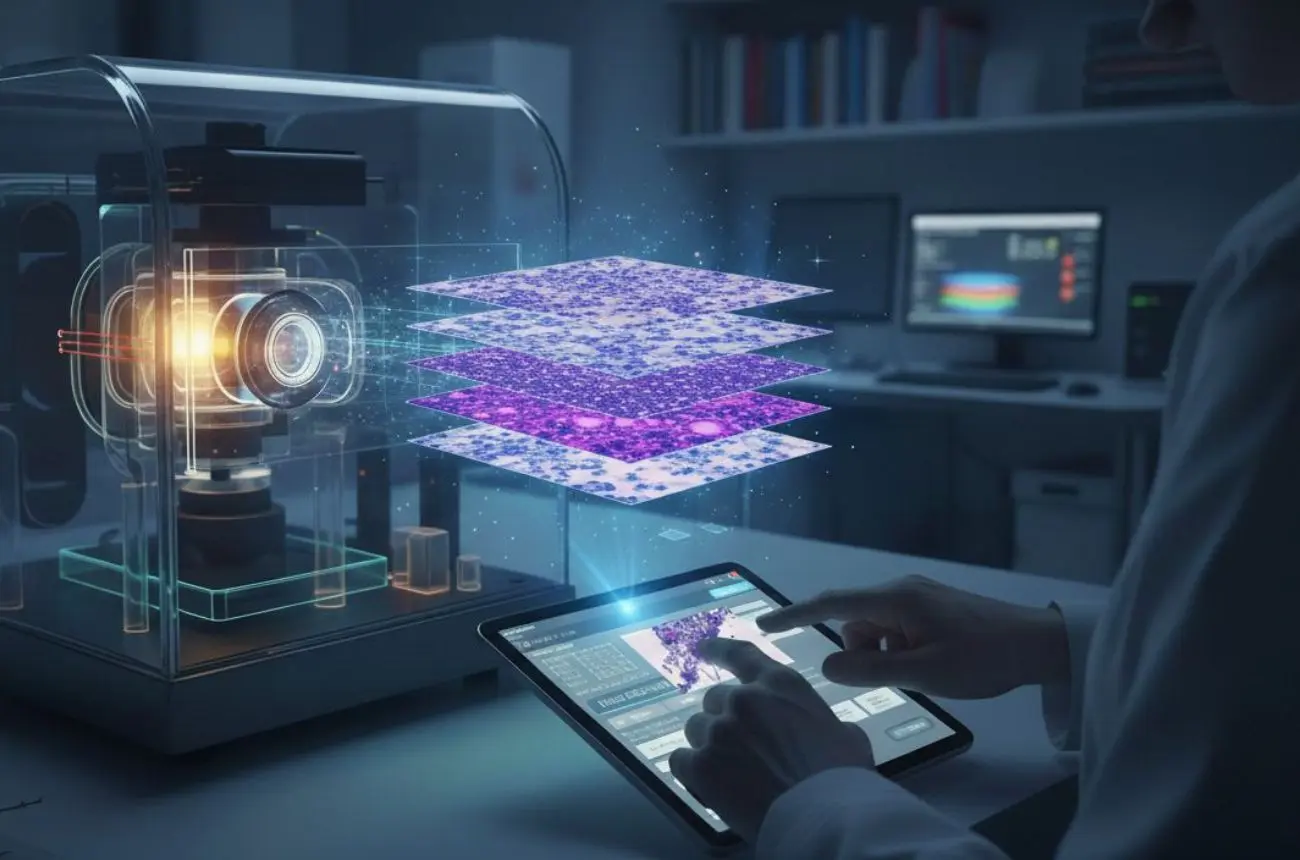
A scanning technique where multiple focal planes are captured at different depths and combined, ensuring structures at varying heights remain in focus.
Whole Slide Scanning
The digitization of an entire slide, producing a navigable digital image comparable to traditional microscopy.
Conventional scanning assumes a relatively flat tissue surface. In reality, many specimens are uneven due to tissue folding, variable thickness, or three-dimensional cellular arrangements. In Slide Scanner Histology workflows, this can result in:
For labs handling cytology, hematopathology, or complex resections, Z-stacking is not optional—it is essential.
A Z-stacking workflow typically includes:
This process increases data volume but significantly improves diagnostic reliability for challenging specimens.
Z-stacking demands highly accurate and repeatable focus mechanisms. Even minor mechanical drift can compromise image alignment across planes.
Labs should be able to control how many focal planes are captured and at what intervals; balancing quality against file size and scan time.
A capable Digital pathology scanner maintains consistent brightness, color, and sharpness across all Z-layers, avoiding visual artifacts.
Z-stacking increases scan time and file size. Scanner hardware and software must be optimized to handle this without disrupting lab throughput.
Improved Diagnostic Confidence
Z-stacking ensures diagnostically relevant structures are visible, even in uneven or thick specimens.
Reduced Rescans
Capturing depth information upfront minimizes the need for repeat scanning.
Microscope-Like Experience
Pathologists can navigate focus planes digitally, closely mimicking manual microscopy.
This makes it important to selectively apply Z-stacking rather than using it universally.
For primary diagnosis, Z-stacked images must be validated to ensure diagnostic equivalence with glass slides. Labs must demonstrate:
Scanner reliability becomes especially critical when Z-stacking is part of routine workflows.
Z-stacking is particularly valuable in:
In these settings, the Pathology slide scanner is expected to handle variability rather than assume ideal specimens.
When selecting a scanner for thick sections and Z-stacking, labs should ask:
Scanning Capability
Performance
Data Management
Cost Considerations
Selecting a scanner without evaluating Z-stacking performance can limit its usefulness for complex specimens.
Z-stacking is evolving rapidly, driven by:
As AI adoption increases, high-quality Z-stack data will become even more valuable for computational pathology.
Morphle Labs designs digital pathology scanners with challenging real-world specimens in mind. By emphasizing precise focus control, reliable automation, and configurable scanning parameters, Morphle supports labs that routinely handle thick sections and uneven tissues.
Rather than forcing a one-size-fits-all approach, Morphle Labs enables labs to apply advanced features like Z-stacking where they add diagnostic value; without compromising overall workflow efficiency.
Not all slides are flat; and your scanner shouldn’t assume they are.
If your lab handles thick sections, cytology, or complex specimens, selecting the right Digital pathology scanner with reliable Z-stacking is critical for diagnostic confidence. See a sample scan here


.webp)
.webp)
.webp)
.webp)
.webp)
.webp)