Key Components of a Whole Slide Imaging System

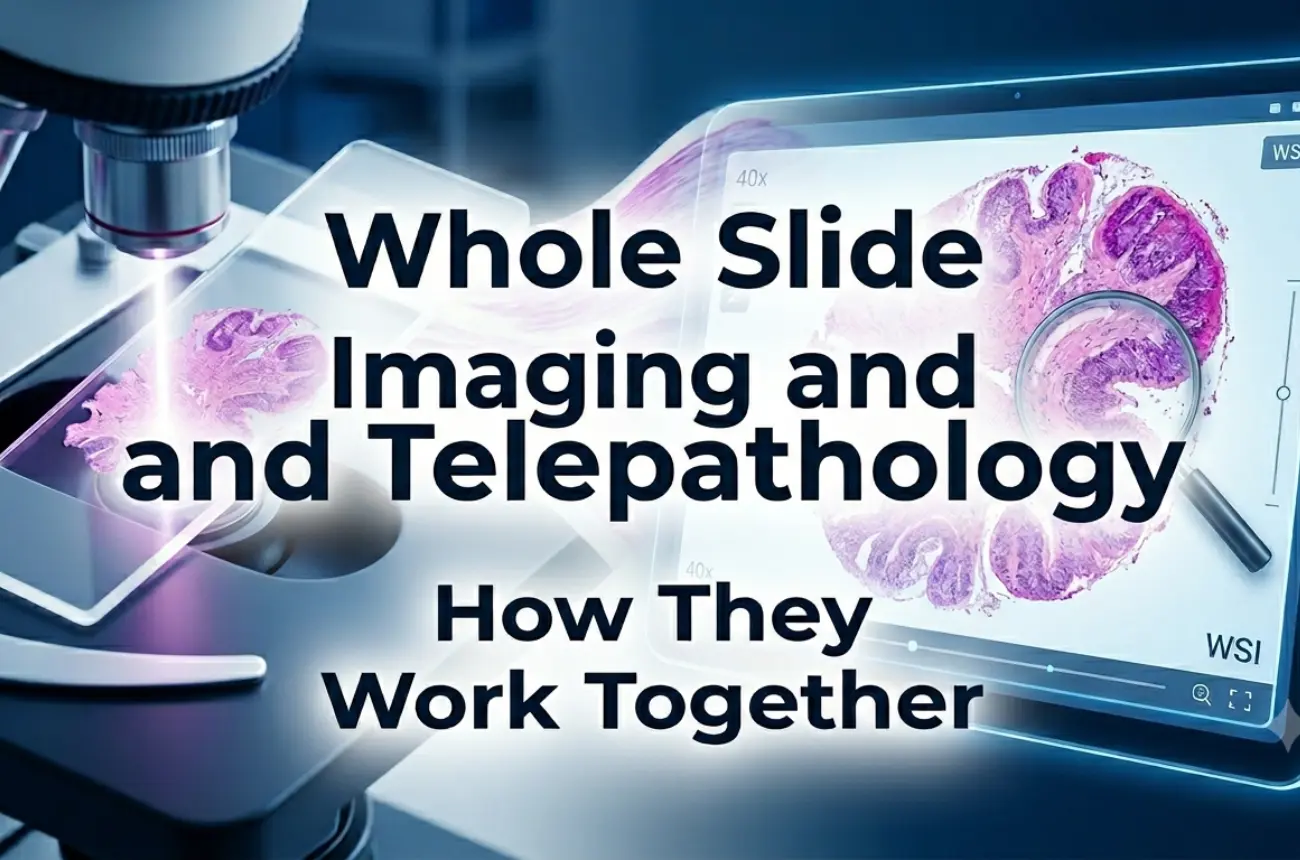
A whole slide imaging system (WSI) converts glass slides into high-resolution digital files that can be viewed, shared, analyzed, and archived. A complete WSI solution includes high-quality optical hardware, a fast and accurate digital pathology scanner, secure storage, an intuitive WSI viewer, and workflow tools including AI and telepathology features. Understanding these components helps labs choose a platform optimized for quality, throughput, and diagnostic confidence.
7 mins

Key Components of a Whole Slide Imaging System

TL;DR

A whole slide imaging system (WSI) converts glass slides into high-resolution digital files that can be viewed, shared, analyzed, and archived. A complete WSI solution includes high-quality optical hardware, a reliable digital pathology scanner, efficient image processing, scalable storage, an intuitive WSI viewer, and workflow tools including AI and tele-pathology features. Understanding how these components work together helps laboratories choose a platform optimized for image quality, throughput, and diagnostic confidence.

What You’ll Learn

  • The core components that make up a whole slide imaging system
  • How scanners, optics, image processing, and software shape digital pathology workflows
  • Key evaluation parameters for lab managers and researchers
  • Practical tips for smooth adoption of digital pathology

Definitions

Whole Slide Imaging (WSI)
Digitizing entire glass slides at high resolution for virtual microscopy.

Digital Pathology Scanner
Hardware that captures images of slides using precision optics, cameras, and automated mechanics.

WSI Viewer
Software that allows pathologists to pan, zoom, annotate, collaborate, and analyze slides; ideally with microscope-like responsiveness.

Telepathology
Reviewing and diagnosing slides remotely via secure streaming or shared digital files.

DICOM Pathology
Standards that enable interoperability with LIS/PACS systems and long-term archival of digital slides.

AI in Histopathology
Algorithms designed to assist with tissue detection, quantification, quality control, and decision support.

A Workflow View: From Slide to Diagnosis

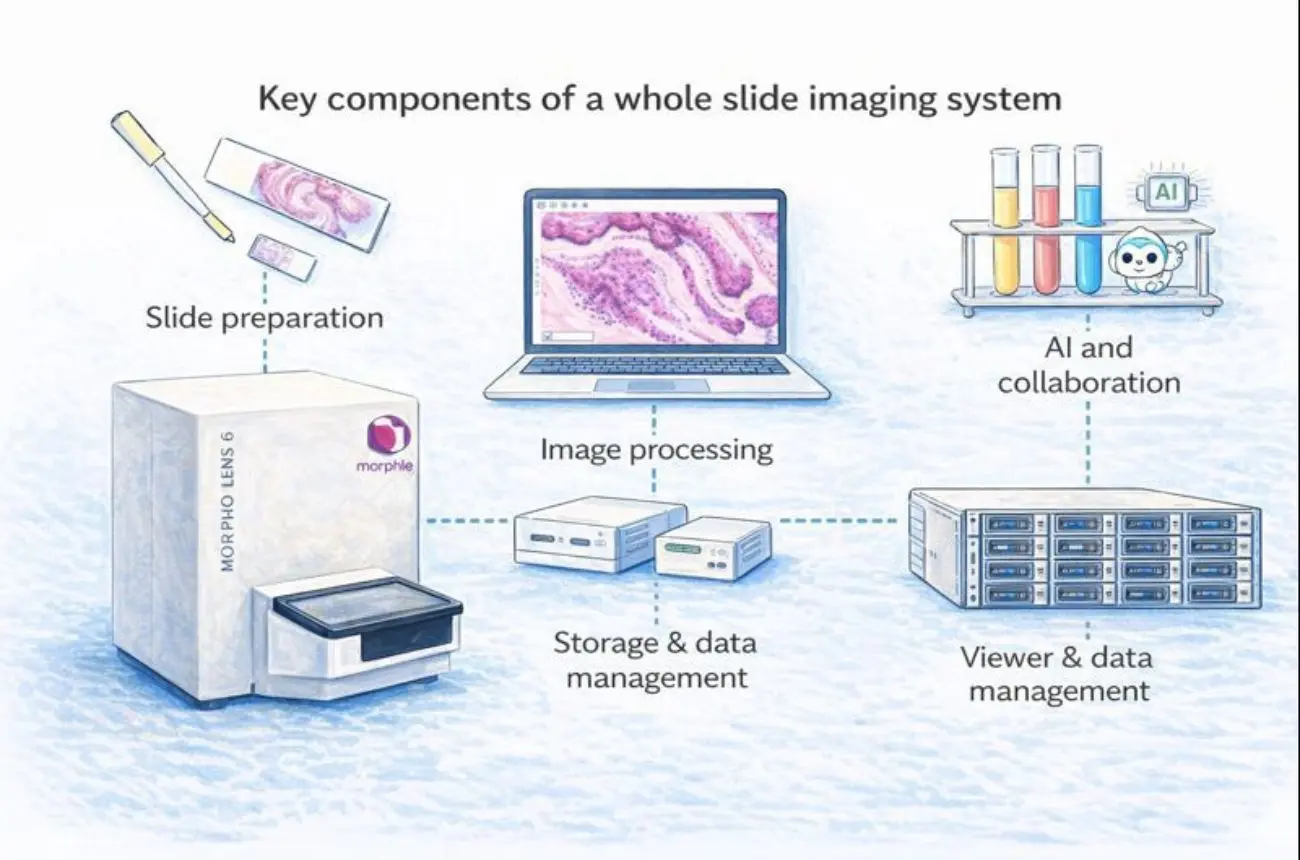
Whole slide imaging is more than scanning; it represents a full digital workflow transformation:

  • Slide preparation
  • Scanning hardware
  • Image processing
  • Storage & data management
  • Viewer & workflow software
  • AI and collaboration

Each step affects diagnostic quality, turnaround time, and long-term scalability. Let’s break them down.

1. Optics: Driving Image Quality

Optics determine whether critical diagnostic structures are visible; from nuclear morphology to IHC marker expression.

Key optical characteristics include:

  • 20× and 40× objectives (high numerical aperture improves clarity)
  • Stable LED illumination for consistent color reproduction
  • Reliable autofocus across uneven tissue surfaces

High-quality optics reduce rescans, minimize uncertainty, and improve diagnostic confidence. Modern digital pathology scanners, including platforms such as Morphle’s, prioritize optical stability to ensure consistent performance across routine and high-volume workflows.

2. Cameras & Sensors: Resolution and Speed

Once light passes through the optics, cameras and sensors convert it into digital data.

Important specifications:

  • Sensor resolution and pixel size (balancing noise vs. detail)
  • Frame rates that enable fast scanning without compromising quality
  • Accurate color reproduction for H&E and IHC consistency

A well-matched optics-camera combination supports both throughput and image fidelity; especially important for labs processing large daily volumes.

3. Scanner Mechanics: Precision in Motion

Whole slide imaging requires capturing thousands of microscopic fields of view with micron-level accuracy.

Critical mechanical components include:

  • Robotic slide loading (from single slides to 200+ capacity)
  • High-precision stage movement to prevent stitching artifacts
  • Rapid focus mapping for thick or uneven tissue sections

As case volumes grow, scanner reliability and uptime become as important as raw scan speed. Vendors like Morphle design scanners with workflow continuity in mind, ensuring consistent performance during extended scanning runs.

4. Image Processing & Stitching

Image processing software merges thousands of image tiles into a seamless whole slide image.

Core processing tasks include:

  • Real-time compression to control file size
  • Stitching and illumination correction
  • Color normalization across batches
  • Multi-resolution image pyramids for fast viewing

Smooth panning and instant tile loading begin at this stage. Efficient processing directly impacts the responsiveness of the WSI viewer downstream.

5. Storage & File Management

A single whole slide image can range from 0.5 to 2.5 GB. At scale, storage planning becomes critical.

Common deployment models:

  • On-premises: Full control and local speed
  • Cloud: Remote access and elastic scalability
  • Hybrid: Balanced approach for multi-site organizations

File format considerations:

  • Proprietary formats (SVS, NDPI) vs. open standards (OME-TIFF)
  • DICOM-WSI for interoperability and long-term archiving

Modern WSI platforms; including Morphle’s; support flexible deployment options so labs can scale storage without locking themselves into a single architecture.

6. The WSI Viewer: User Experience Is Everything

The viewer is where pathologists spend most of their time, and adoption depends heavily on performance.

Key features to look for:

  • Microscope-like intuitive navigation
  • Fast pan and zoom across laptops, desktops, and tablets
  • Annotation, measurement, and region-of-interest tools
  • Secure remote access for telepathology
  • AI overlays for detection, quantification, and grading

Even the most advanced scanner hardware can fail adoption if the viewer feels laggy or unintuitive. Many modern systems, including Morphle’s digital pathology solutions, emphasize low-latency streaming and responsive interfaces to mimic the experience of traditional microscopy.

7. Workflow, Telepathology & Integrations

Digital pathology succeeds when it integrates seamlessly into existing laboratory processes.

Key workflow capabilities:

  • Barcode-based case tracking
  • LIS and PACS integrations (HL7, DICOM)
  • Secure remote consultations
  • Multi-viewer collaboration for tumor boards and education

Telepathology enables faster access to subspecialty expertise, improving turnaround time and diagnostic safety; especially for distributed or resource-limited labs.

8. AI in Histopathology

AI does not replace pathologists—it supports them.

Common applications include:

  • Tissue quality control and focus assessment
  • Tumor region identification
  • Automated cell counting and IHC scoring
  • Risk stratification for research and clinical studies

When integrated thoughtfully into the workflow, AI improves consistency and enables scalable analysis without disrupting diagnostic judgment.

How to Choose the Right WSI System

When evaluating a whole slide imaging system, consider:

Throughput & scalability
Can the system handle today’s volumes and future growth?

Viewer responsiveness
Does it provide a microscope-like experience on standard devices?

Deployment flexibility
Does it support on-prem, cloud, or hybrid architectures?

Integration readiness
Will it fit smoothly into existing LIS/PACS workflows?

Total cost of ownership
Consider storage, service contracts, AI modules, maintenance, and uptime guarantees. A system that appears cheaper upfront may cost more operationally over time.

Practical Tips for Smooth Adoption

  • Pilot first: Benchmark scan times, viewer performance, and pathologist feedback
  • Standardize slide preparation: Reduces rescans and variability
  • Train pathologists early: Comfort with digital tools improves accuracy
  • Track uptime metrics: Ensures consistent throughput
  • Choose a supportive vendor: Responsive service is as important as hardware

Digital pathology is a transformation; not just a purchase.

How Morphle Supports a Complete Whole Slide Imaging Workflow

Morphle’s digital pathology platform is designed to align with the core components of a modern whole slide imaging system; focusing on reliability, usability, and scalability rather than isolated features.

Morphle scanners combine high-quality optics, precise mechanics, and stable illumination to deliver consistent image quality across routine and high-volume workflows. The image processing and viewing pipeline is optimized for smooth stitching, fast pan-and-zoom performance, and a microscope-like user experience that supports confident digital sign-out.

To accommodate diverse IT environments, Morphle supports on-premises, cloud, and hybrid deployment models, allowing laboratories to scale storage while maintaining control over data and compliance. Built-in workflow integration, secure remote access, and AI-ready architecture further enable telepathology, collaboration, and future adoption of computational pathology tools.

Conclusion

A successful whole slide imaging system unifies:

  • High-precision scanning hardware
  • Intelligent image processing
  • Fast, fluid WSI viewing
  • Scalable storage and secure access
  • Workflow tools and AI-assisted analytics

Together, these components enable pathologists to work faster, collaborate more effectively, and unlock new diagnostic insights through virtual microscopy and telepathology.

Want personalized guidance on choosing the right scanner for your workflow?

Explore how Morphle supports laboratories with flexible deployment options and a 30-day risk-free evaluation.

Learn more about digital pathology and various usecases

Read More
Contact Us
Afghanistan (+93)
Albania (+355)
Algeria (+213)
American Samoa (+1-684)
Andorra (+376)
Angola (+244)
Anguilla (+1-264)
Antarctica (+672)
Antigua and Barbuda (+1-268)
Argentina (+54)
Armenia (+374)
Aruba (+297)
Australia (+61)
Austria (+43)
Azerbaijan (+994)
Bahamas (+1-242)
Bahrain (+973)
Bangladesh (+880)
Barbados (+1-246)
Belarus (+375)
Belgium (+32)
Belize (+501)
Benin (+229)
Bermuda (+1-441)
Bhutan (+975)
Bolivia (+591)
Bosnia and Herzegovina (+387)
Botswana (+267)
Brazil (+55)
British Indian Ocean Territory (+246)
Brunei (+673)
Bulgaria (+359)
Burkina Faso (+226)
Burundi (+257)
Cambodia (+855)
Cameroon (+237)
Canada (+1)
Cape Verde (+238)
Cayman Islands (+1-345)
Central African Republic (+236)
Chad (+235)
Chile (+56)
China (+86)
Christmas Island (+53)
Cocos Islands (+61)
Colombia (+57)
Comoros (+269)
Congo (DRC) (+243)
Congo (Republic) (+242)
Cook Islands (+682)
Costa Rica (+506)
Cote D'Ivoire (+225)
Croatia (+385)
Cuba (+53)
Cyprus (+357)
Czech Republic (+420)
Denmark (+45)
Djibouti (+253)
Dominica (+1-767)
Dominican Republic (+1-809 and +1-829  )
East Timor (+670)
Ecuador (+593 )
Egypt (+20)
El Salvador (+503)
Equatorial Guinea (+240)
Eritrea (+291)
Estonia (+372)
Ethiopia (+251)
Falkland Islands (+500)
Faroe Islands (+298)
Fiji (+679)
Finland (+358)
France (+33)
French Guiana (+594)
French Polynesia (+689)
Gabon (+241)
Gambia (+220)
Georgia (+995)
Germany (+49)
Ghana (+233)
Gibraltar (+350)
Greece (+30)
Greenland (+299)
Grenada (+1-473)
Guadeloupe (+590)
Guam (+1-671)
Guatemala (+502)
Guinea (+224)
Guinea-Bissau (+245)
Guyana (+592)
Haiti (+509)
Honduras (+504)
Hong Kong (+852)
Hungary (+36)
Iceland (+354)
India (+91)
Indonesia (+62)
Iran (+98)
Iraq (+964)
Ireland (+353)
Israel (+972)
Italy (+39)
Jamaica (+1-876)
Japan (+81)
Jordan (+962)
Kazakhstan (+7)
Kenya (+254)
Kiribati (+686)
Kuwait (+965)
Kyrgyzstan (+996)
Laos (+856)
Latvia (+371)
Lebanon (+961)
Lesotho (+266)
Liberia (+231)
Libya (+218)
Liechtenstein (+423)
Lithuania (+370)
Luxembourg (+352)
Macau (+853)
Macedonia (+389)
Madagascar (+261)
Malawi (+265)
Malaysia (+60)
Maldives (+960)
Mali (+223)
Malta (+356)
Marshall Islands (+692)
Martinique (+596)
Mauritania (+222)
Mauritius (+230)
Mayotte (+269)
Mexico (+52)
Micronesia (+691)
Moldova (+373)
Monaco (+377)
Mongolia (+976)
Montserrat (+1-664)
Morocco (+212)
Mozambique (+258)
Myanmar (+95)
Namibia (+264)
Nauru (+674)
Nepal (+977)
Netherlands (+31)
Netherlands Antilles (+599)
New Caledonia (+687)
New Zealand (+64)
Nicaragua (+505)
Niger (+227)
Nigeria (+234)
Niue (+683)
Norfolk Island (+672)
Northern Mariana Islands (+1-670)
North Korea (+850)
Norway (+47)
Oman (+968)
Pakistan (+92)
Palau (+680)
Palestinian State (+970)
Panama (+507)
Papua New Guinea (+675)
Paraguay (+595)
Peru (+51)
Philippines (+63)
Poland (+48)
Portugal (+351)
Puerto Rico (+1-787 or +1-939)
Qatar (+974 )
Reunion (+262)
Romania (+40)
Russia (+7)
Rwanda (+250)
Saint Helena (+290)
Saint Kitts and Nevis (+1-869)
Saint Lucia (+1-758)
Saint Pierre and Miquelon (+508)
Saint Vincent and the Grenadines (+1-784)
Samoa (+685)
San Marino (+378)
Sao Tome and Principe (+239)
Saudi Arabia (+966)
Senegal (+221)
Serbia (+381)
Seychelles (+248)
Sierra Leone (+232)
Singapore (+65)
Slovakia (+421)
Slovenia (+386)
Solomon Islands (+677)
Somalia (+252)
South Africa (+27)
South Korea (+82)
South Sudan (+211)
Spain (+34)
Sri Lanka (+94)
Sudan (+249)
Suriname (+597)
Svalbard and Jan Mayen Islands (+47)
Swaziland (+268)
Sweden (+46)
Switzerland (+41)
Syria (+963)
Taiwan (+886)
Tajikistan (+992)
Tanzania (+255)
Thailand (+66)
Togo (+228)
Tokelau (+690)
Tonga (+676)
Trinidad and Tobago (+1-868)
Tunisia (+216)
Turkey (+90)
Turkmenistan (+993)
Turks and Caicos Islands (+1-649)
Tuvalu (+688)
Uganda (+256)
Ukraine (+380)
United Arab Emirates (+971)
United Kingdom (+44)
United States (+1)
Uruguay (+598)
Uzbekistan (+998)
Vanuatu (+678)
Vatican City State (+418)
Venezuela (+58)
Vietnam (+84)
Virgin Islands, British (+1-284)
Virgin Islands, United States (+1-340)
Wallis and Futuna Islands (+681)
Western Sahara (+212)
Yemen (+967)
Zambia (+260)
Zimbabwe (+263)