Case Study: Lowering Turnaround Time with Telepathology

Case studies show how telepathology using digital pathology scanners reduces diagnostic turnaround time by 30–67% while maintaining clinical accuracy.
6 mins

Case Study: Lowering Turnaround Time with Telepathology Using Digital Pathology Scanners

TL;DR

Telepathology significantly reduces diagnostic turnaround time by eliminating physical slide transport and enabling rapid access to subspecialty expertise. Case studies across cloud-based national networks, international consultation programs, and frozen section services demonstrate turnaround time reductions ranging from 30% to 67%, while maintaining diagnostic accuracy above 98%. Successful outcomes depend on the performance of the digital pathology scanner, network infrastructure, workflow integration, and validation practices.

What You’ll Learn

  • How telepathology reduces diagnostic turnaround time in real-world clinical settings

  • The role of digital pathology scanners in enabling fast, accurate remote diagnosis

  • Measured outcomes from national, international, and frozen section telepathology programs

  • Technical and workflow requirements for scalable telepathology

  • Key considerations when selecting a whole slide imaging platform

Understanding Telepathology and Turnaround Time

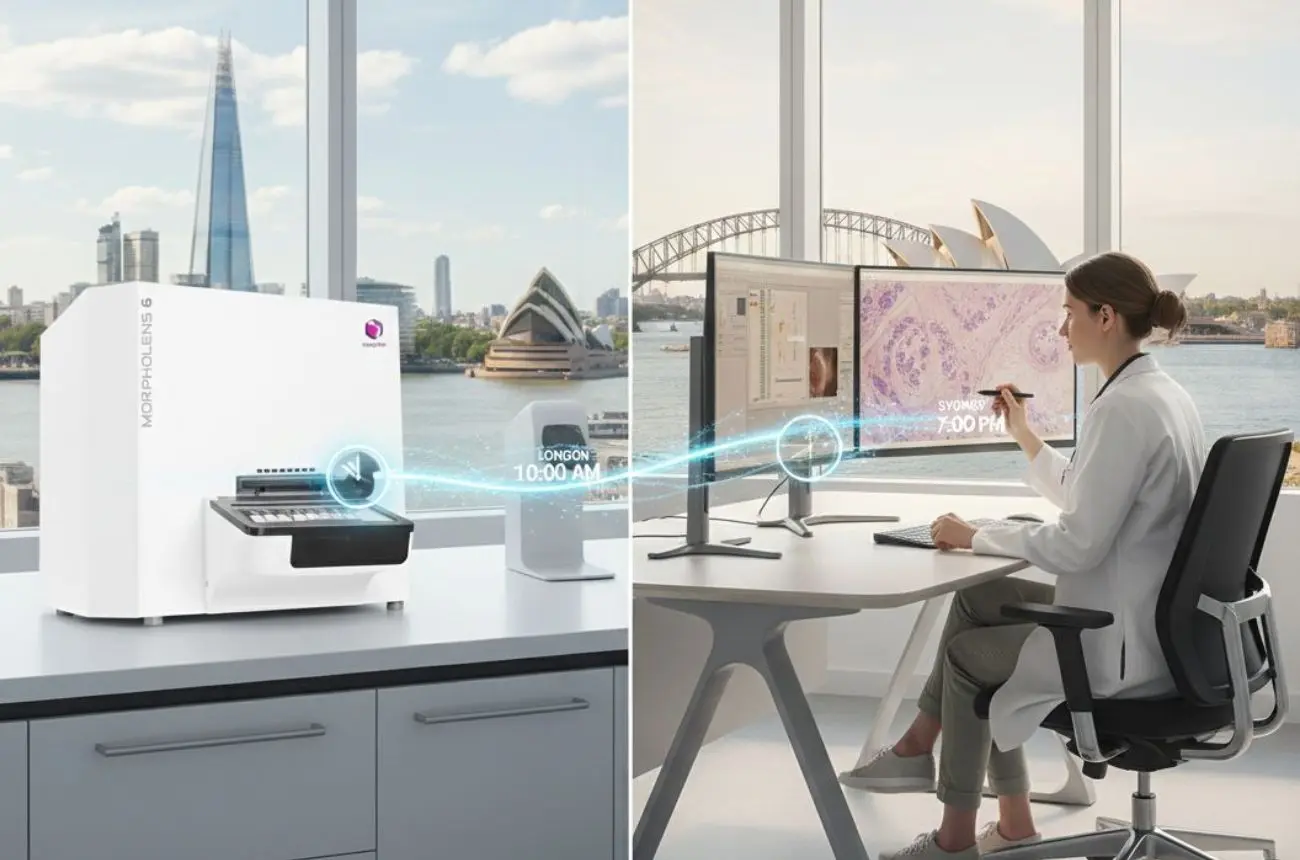
Telepathology refers to the remote interpretation of pathology slides using whole slide imaging and digital communication technologies. Glass slides are digitized using a pathology slide scanner, then securely transmitted to pathologists for primary diagnosis, consultation, or intraoperative decision-making.

Turnaround time (TAT); the interval between specimen receipt and diagnostic report delivery; is a critical performance metric in pathology. Delays in turnaround time can directly impact surgical decisions, treatment initiation, and patient outcomes. Traditional workflows that rely on physical slide transport often introduce delays of several days or weeks, particularly for subspecialty consultation.

Telepathology removes these geographic constraints, allowing cases to be reviewed within hours rather than days.

Case Study 1: National Cloud-Based Telepathology in China

The Chinese National Cloud-Based Telepathology System evaluated 23,167 consultation cases across 83 hospitals between 2016 and 2019.

Key Results

  • Median turnaround time decreased from ~29 hours (2016) to ~10 hours (2019)

  • Overall improvement of 67% in diagnostic turnaround time

  • Diagnostic accuracy remained high at 98.05%

  • Annual case volume increased by 41%, reflecting growing clinical trust

A cloud-based whole slide imaging architecture enabled rapid access to large digital pathology files while supporting nationwide scalability. The program also reduced patient travel and repeat testing, saving an estimated $300,000 annually.

Case Study 2: International Telepathology Consultation Networks

An international telepathology collaboration between UPMC (USA) and KingMed Diagnostics (China) illustrates the value of digital pathology for subspecialty consultation.

Key Results

  • Average turnaround time reduced from 6.8 days to 5.0 days

  • Hematopathology, gynecologic, breast, and soft tissue cases benefited most

  • Subspecialist review altered diagnoses in ~50% of referred cases, impacting treatment decisions

This case study demonstrates that telepathology improves not only speed, but also diagnostic accuracy and clinical confidence, particularly for complex cases.

Case Study 3: Frozen Section Telepathology

Frozen section diagnosis demands rapid turnaround times measured in minutes rather than days.

Rwanda Telepathology Program

  • International shipment: 30 days median TAT

  • Static image telepathology: 14 days

  • Onsite expert diagnosis: 5 days

  • Telepathology alone achieved a 53% TAT reduction

Eastern Québec Telepathology Network

  • Average frozen section turnaround time: ~20 minutes

  • Diagnostic concordance: 98%

  • Enabled surgical coverage for hospitals without onsite pathologists

These outcomes show that telepathology, when supported by high-speed automated microscope slide scanners, can meet or exceed conventional frozen section standards.

How Digital Pathology Scanners Enable Faster Turnaround

Reducing telepathology turnaround time requires optimized performance across multiple technical layers.

Digital Pathology Scanner Performance

A digital pathology scanner must deliver:

  • High spatial resolution (≤ 0.25 microns per pixel at 40×)

  • Accurate color reproduction for stained tissue

  • Fast scanning speeds without compromising focus quality

Modern whole slide scanners can digitize a standard 15 × 15 mm tissue section in under 60 seconds, ensuring scanning does not become a bottleneck.

Network and Storage Infrastructure

Whole slide images are large, often multiple gigabytes per slide. Efficient telepathology workflows rely on:

  • Intelligent compression (reducing file size by 70–80%)

  • Cloud-based storage with rapid access

  • Reliable bandwidth for rural or resource-limited settings

Viewer and LIS Integration

Smooth navigation, low-latency viewing, and integration with laboratory information systems (LIS) are essential. Automated case routing, alerts, and reporting workflows directly reduce interpretation and reporting time.

Workflow Optimization Strategies

High-performing telepathology programs implement workflow changes alongside technology adoption:

  • Standardized slide preparation to reduce rescans

  • Automated tissue detection to minimize manual intervention

  • Barcode-driven case tracking and prioritization

  • Urgent case queuing for frozen sections and oncology

Veterans Affairs telepathology programs reported reductions in viewing time from 3.44 minutes to 1.13 minutes per slide, with total case turnaround time decreasing from 2.46 days to 1.5 days or less as pathologists gained experience.

Benefits Beyond Turnaround Time

While turnaround time is the primary metric, telepathology delivers additional advantages:

  • Expanded access to subspecialty expertise

  • Reduced patient travel and associated costs

  • Permanent digital slide archiving

  • Improved education, quality assurance, and second opinions

Hematopathology programs report ~30% average TAT reduction alongside improved diagnostic consistency.

Implementation Challenges and Mitigation

Common telepathology challenges include:

  • Capital investment in slide scanner histology systems

  • Pathologist adoption and learning curves

  • Regulatory validation requirements

  • Network reliability and cybersecurity

These are addressed through phased implementation, structured training, institution-specific validation studies, and robust vendor support.

Selecting a Digital Pathology Platform for Telepathology

When evaluating telepathology solutions, laboratories should assess:

  • Scanning speed aligned with case volume

  • Diagnostic-grade resolution and color accuracy

  • Open or interoperable file formats

  • Storage efficiency and cloud readiness

For laboratories seeking scalable telepathology solutions, Morphle Labs offers digital pathology scanners designed for both performance and accessibility. Their platforms deliver 0.22 microns per pixel resolution, scan times of 90–250 seconds, and compact file formats that reduce storage costs by approximately 75%. Multiple configurations support use cases ranging from low-volume research to high-throughput clinical networks while maintaining consistent imaging standards.

Future Trends in Telepathology

Advancements shaping the next phase of telepathology include:

  • AI-assisted prescreening and prioritization

  • Real-time multi-pathologist collaboration

  • Edge computing and advanced compression

  • Interoperable whole slide imaging standards

These developments will further reduce turnaround time and expand telepathology adoption globally.

Conclusion: Telepathology as a Proven Turnaround Time Strategy

Evidence across multiple healthcare systems confirms that telepathology—powered by high-quality digital pathology scanners; can reduce diagnostic turnaround time by 30–67% without compromising accuracy. When implemented with appropriate technology, workflows, and validation, telepathology improves patient outcomes, clinician efficiency, and access to expertise.

Reduce telepathology turnaround time with a validated digital pathology scanner.

Discover how Morphle Labs’ whole slide imaging platforms support fast, accurate remote diagnosis. Request a demo here.

Learn more about digital pathology and various usecases

Read More
Contact Us
Afghanistan (+93)
Albania (+355)
Algeria (+213)
American Samoa (+1-684)
Andorra (+376)
Angola (+244)
Anguilla (+1-264)
Antarctica (+672)
Antigua and Barbuda (+1-268)
Argentina (+54)
Armenia (+374)
Aruba (+297)
Australia (+61)
Austria (+43)
Azerbaijan (+994)
Bahamas (+1-242)
Bahrain (+973)
Bangladesh (+880)
Barbados (+1-246)
Belarus (+375)
Belgium (+32)
Belize (+501)
Benin (+229)
Bermuda (+1-441)
Bhutan (+975)
Bolivia (+591)
Bosnia and Herzegovina (+387)
Botswana (+267)
Brazil (+55)
British Indian Ocean Territory (+246)
Brunei (+673)
Bulgaria (+359)
Burkina Faso (+226)
Burundi (+257)
Cambodia (+855)
Cameroon (+237)
Canada (+1)
Cape Verde (+238)
Cayman Islands (+1-345)
Central African Republic (+236)
Chad (+235)
Chile (+56)
China (+86)
Christmas Island (+53)
Cocos Islands (+61)
Colombia (+57)
Comoros (+269)
Congo (DRC) (+243)
Congo (Republic) (+242)
Cook Islands (+682)
Costa Rica (+506)
Cote D'Ivoire (+225)
Croatia (+385)
Cuba (+53)
Cyprus (+357)
Czech Republic (+420)
Denmark (+45)
Djibouti (+253)
Dominica (+1-767)
Dominican Republic (+1-809 and +1-829  )
East Timor (+670)
Ecuador (+593 )
Egypt (+20)
El Salvador (+503)
Equatorial Guinea (+240)
Eritrea (+291)
Estonia (+372)
Ethiopia (+251)
Falkland Islands (+500)
Faroe Islands (+298)
Fiji (+679)
Finland (+358)
France (+33)
French Guiana (+594)
French Polynesia (+689)
Gabon (+241)
Gambia (+220)
Georgia (+995)
Germany (+49)
Ghana (+233)
Gibraltar (+350)
Greece (+30)
Greenland (+299)
Grenada (+1-473)
Guadeloupe (+590)
Guam (+1-671)
Guatemala (+502)
Guinea (+224)
Guinea-Bissau (+245)
Guyana (+592)
Haiti (+509)
Honduras (+504)
Hong Kong (+852)
Hungary (+36)
Iceland (+354)
India (+91)
Indonesia (+62)
Iran (+98)
Iraq (+964)
Ireland (+353)
Israel (+972)
Italy (+39)
Jamaica (+1-876)
Japan (+81)
Jordan (+962)
Kazakhstan (+7)
Kenya (+254)
Kiribati (+686)
Kuwait (+965)
Kyrgyzstan (+996)
Laos (+856)
Latvia (+371)
Lebanon (+961)
Lesotho (+266)
Liberia (+231)
Libya (+218)
Liechtenstein (+423)
Lithuania (+370)
Luxembourg (+352)
Macau (+853)
Macedonia (+389)
Madagascar (+261)
Malawi (+265)
Malaysia (+60)
Maldives (+960)
Mali (+223)
Malta (+356)
Marshall Islands (+692)
Martinique (+596)
Mauritania (+222)
Mauritius (+230)
Mayotte (+269)
Mexico (+52)
Micronesia (+691)
Moldova (+373)
Monaco (+377)
Mongolia (+976)
Montserrat (+1-664)
Morocco (+212)
Mozambique (+258)
Myanmar (+95)
Namibia (+264)
Nauru (+674)
Nepal (+977)
Netherlands (+31)
Netherlands Antilles (+599)
New Caledonia (+687)
New Zealand (+64)
Nicaragua (+505)
Niger (+227)
Nigeria (+234)
Niue (+683)
Norfolk Island (+672)
Northern Mariana Islands (+1-670)
North Korea (+850)
Norway (+47)
Oman (+968)
Pakistan (+92)
Palau (+680)
Palestinian State (+970)
Panama (+507)
Papua New Guinea (+675)
Paraguay (+595)
Peru (+51)
Philippines (+63)
Poland (+48)
Portugal (+351)
Puerto Rico (+1-787 or +1-939)
Qatar (+974 )
Reunion (+262)
Romania (+40)
Russia (+7)
Rwanda (+250)
Saint Helena (+290)
Saint Kitts and Nevis (+1-869)
Saint Lucia (+1-758)
Saint Pierre and Miquelon (+508)
Saint Vincent and the Grenadines (+1-784)
Samoa (+685)
San Marino (+378)
Sao Tome and Principe (+239)
Saudi Arabia (+966)
Senegal (+221)
Serbia (+381)
Seychelles (+248)
Sierra Leone (+232)
Singapore (+65)
Slovakia (+421)
Slovenia (+386)
Solomon Islands (+677)
Somalia (+252)
South Africa (+27)
South Korea (+82)
South Sudan (+211)
Spain (+34)
Sri Lanka (+94)
Sudan (+249)
Suriname (+597)
Svalbard and Jan Mayen Islands (+47)
Swaziland (+268)
Sweden (+46)
Switzerland (+41)
Syria (+963)
Taiwan (+886)
Tajikistan (+992)
Tanzania (+255)
Thailand (+66)
Togo (+228)
Tokelau (+690)
Tonga (+676)
Trinidad and Tobago (+1-868)
Tunisia (+216)
Turkey (+90)
Turkmenistan (+993)
Turks and Caicos Islands (+1-649)
Tuvalu (+688)
Uganda (+256)
Ukraine (+380)
United Arab Emirates (+971)
United Kingdom (+44)
United States (+1)
Uruguay (+598)
Uzbekistan (+998)
Vanuatu (+678)
Vatican City State (+418)
Venezuela (+58)
Vietnam (+84)
Virgin Islands, British (+1-284)
Virgin Islands, United States (+1-340)
Wallis and Futuna Islands (+681)
Western Sahara (+212)
Yemen (+967)
Zambia (+260)
Zimbabwe (+263)