Automated Slide Scanners in Histology: An Introduction

Automated slide scanners are transforming histology by digitizing glass slides into high-resolution whole-slide images, enabling faster diagnosis, remote reporting, and AI-driven insights. As digital pathology adoption accelerates globally, a Digital Pathology slide scanner is becoming a foundational tool for modern labs.
5 mins

Automated Slide Scanners in Histology: An Introduction

TL;DR

Automated slide scanners are transforming histology by digitizing glass slides into high-resolution whole-slide images, enabling faster diagnosis, remote reporting, and AI-driven insights. As digital pathology adoption accelerates globally, a Digital Pathology slide scanner is becoming a foundational tool for modern labs.

What You’ll Learn

  • What automated slide scanners are and how they work

  • Key technical concepts behind whole-slide imaging

  • Workflow improvements for histology laboratories

  • Benefits and limitations of automated scanning

  • What compliance and quality standards matter

  • How to select the right scanner for your lab

  • Future trends shaping digital pathology

For a deeper primer on digital pathology, explore: Knowledge Hub

Definitions: Understanding the Core Terms

Automated Slide Scanner

A device that automatically loads, scans, and converts glass histology slides into digital images.

Digital Pathology Slide Scanner/ Microscope Slide Scanner

A scanner designed specifically for pathology workflows, optimized for color fidelity, resolution, and diagnostic accuracy.

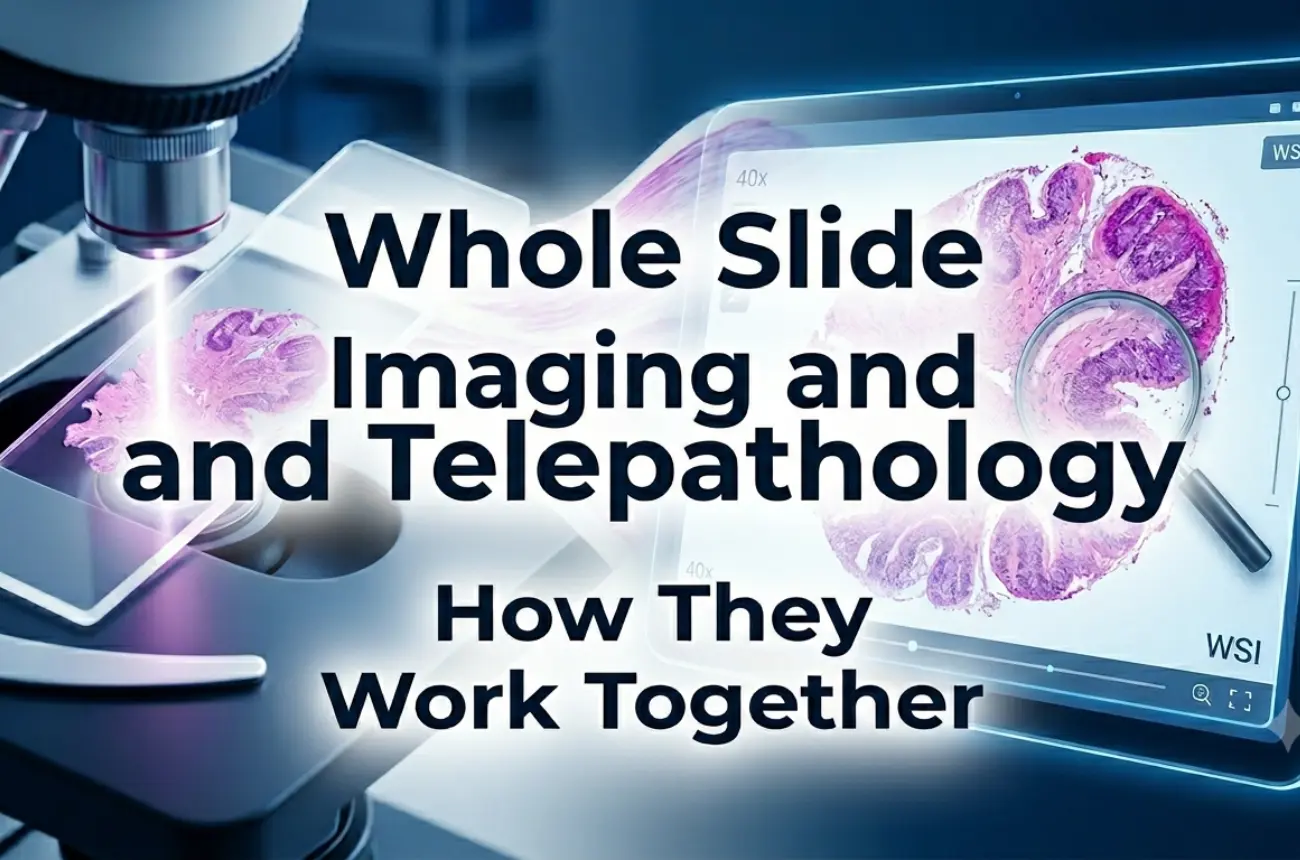
Whole Slide Imaging Scanner / Whole Slide Imaging (WSI)

The technology that captures the entire tissue section at high resolution, allowing pathologists to view it digitally.

Histology Slide Scanner

A system tailored for routine histopathology slides, often used in clinical labs and high-volume workflows.

Digital Slide Scanner Pathology

A scanner integrated with pathology systems, enabling seamless reporting, case tracking, and telepathology.

How Automated Slide Scanners Fit Into the Histology Workflow

Automated slide scanners streamline the histology workflow by reducing manual handling and variability. After tissue processing and staining, slides are loaded into the scanner—either singly or in batches. The system detects tissue, sets focus points, optimizes illumination, and captures thousands of high-resolution fields that are stitched into a single whole-slide image.

These digital images are then uploaded to a secure viewer or LIS-integrated system. Pathologists can access the slides instantly, whether they are in the same facility or working remotely. Automated scanning eliminates bottlenecks caused by slide transport, microscope availability, and geographic constraints.

This shift is especially valuable for multi-site hospitals, high-volume labs, and centers exploring telepathology or AI-assisted workflows.

Technical Factors That Influence Digital Slide Quality

Automated slide scanners differ widely in performance. Understanding the technical concepts helps labs make informed decisions.

Optics and Resolution

High-quality objectives and sensors determine image clarity. A 20X or 40X objective is common, but optical quality matters more than magnification alone.

Focus Technology

Uneven tissue thickness demands advanced autofocus systems, including predictive focus maps and multi-layer scanning.

Color Reproduction

Accurate color calibration ensures stains appear consistent across devices and sessions—critical for diagnosis.

File Size and Compression

Whole-slide images can reach gigabytes in size. Efficient compression and streaming ensure smooth viewing without compromising detail.

Scanning Speed

Speed varies by tissue type, resolution, and scanner design. In high-volume labs, throughput is a primary selection factor.

Viewer Performance

A responsive, microscope-like pan-and-zoom experience is essential. Morphle scanners excel in this area, offering fluid navigation on any device with on-prem, cloud, or hybrid deployment.

Benefits vs Limitations of Automated Slide Scanners

Benefits

Automated slide scanners enhance consistency, reduce manual errors, and increase lab throughput. They enable remote consultations, support teaching and tumor boards, and prepare labs for AI-assisted diagnostics. Digital slides do not degrade over time, eliminating risk of breakage, fading, or misplacement. Automated workflows reduce technician handling and ensure superior traceability.

Limitations

Barriers include initial investment, storage requirements, and IT infrastructure upgrades. Some labs may need cultural or workflow adaptation during the transition from microscopes to digital viewers. Scanning artifacts can occur if slides are improperly prepared. Despite these challenges, long-term efficiency gains outweigh most limitations.

Compliance and Quality Considerations

Digital pathology must align with regulatory frameworks such as HIPAA or GDPR for data protection, as well as CAP guidelines and internal quality policies. Consistent calibration, documented validation, and audit logs are essential.

DICOM pathology is increasingly important for interoperability, archival compliance, and future AI compatibility. Selecting scanners that support secure workflows, encryption, and integration with LIS/PACS systems is critical for long-term sustainability.

Applications of Automated Slide Scanners in Histology

Automated slide scanners support a wide range of use cases:

  • Routine histopathology diagnosis

  • Remote reporting and telepathology

  • Frozen section consultation

  • Tumor board reviews

  • Teaching and research

  • AI-driven quantification and biomarker analysis

  • Multi-site hospital networks

They are especially useful where case volumes are high or where pathologists need rapid access to subspecialty opinions.

Buying Guide: What to Look for in a Digital Pathology Slide Scanner

When selecting a scanner, consider these factors:

  • Optical quality and resolution

  • Autofocus reliability

  • Scan speed and throughput

  • Color accuracy

  • Viewer responsiveness

  • Storage and file compatibility

  • DICOM support

  • Integration with LIS and PACS

  • Security features and audit trails

  • Availability of on-prem, cloud, or hybrid deployment

  • Vendor support, training, and service availability

For labs evaluating mid-volume automated scanning, explore : Robust 6-slide scanner

Future Trends in Automated Slide Scanning

The future of histology is fully digital. Innovations include AI-native scanners, real-time QC detection, automated region-of-interest scanning, and cloud-first WSI platforms. Zero-footprint viewers, predictive scanning algorithms, and AI-enhanced focusing will further reduce turnaround times.

As these technologies evolve, scanners will become faster, more accurate, and easier to integrate—driving widespread adoption even in smaller regional labs.

Where Morphle Fits In

Morphle scanners make automated histology scanning practical and scalable. With robust optics, precise focus control, and a microscope-like viewing experience, Morphle delivers consistent whole-slide image quality across routine and high-volume workflows. Flexible on-prem, cloud, and hybrid deployments allow labs to adopt digital pathology without disrupting existing infrastructure. Designed for reliability and throughput, Morphle helps histology labs transition smoothly to digital workflows while staying ready for tele-pathology and AI adoption.

Conclusion

Automated slide scanners are reshaping histology, enabling faster workflows, greater collaboration, and AI-ready datasets. The best digital Pathology slide scanner for your lab  is no longer a luxury—it is becoming essential infrastructure for modern pathology. With microscope-like navigation, flexible deployment options, and a responsive viewing experience, Morphle scanners make digital workflows accessible and scalable for any lab.

CTA

See automated scanning in action—book a live demonstration.

Learn more about digital pathology and various usecases

Read More
Contact Us
Afghanistan (+93)
Albania (+355)
Algeria (+213)
American Samoa (+1-684)
Andorra (+376)
Angola (+244)
Anguilla (+1-264)
Antarctica (+672)
Antigua and Barbuda (+1-268)
Argentina (+54)
Armenia (+374)
Aruba (+297)
Australia (+61)
Austria (+43)
Azerbaijan (+994)
Bahamas (+1-242)
Bahrain (+973)
Bangladesh (+880)
Barbados (+1-246)
Belarus (+375)
Belgium (+32)
Belize (+501)
Benin (+229)
Bermuda (+1-441)
Bhutan (+975)
Bolivia (+591)
Bosnia and Herzegovina (+387)
Botswana (+267)
Brazil (+55)
British Indian Ocean Territory (+246)
Brunei (+673)
Bulgaria (+359)
Burkina Faso (+226)
Burundi (+257)
Cambodia (+855)
Cameroon (+237)
Canada (+1)
Cape Verde (+238)
Cayman Islands (+1-345)
Central African Republic (+236)
Chad (+235)
Chile (+56)
China (+86)
Christmas Island (+53)
Cocos Islands (+61)
Colombia (+57)
Comoros (+269)
Congo (DRC) (+243)
Congo (Republic) (+242)
Cook Islands (+682)
Costa Rica (+506)
Cote D'Ivoire (+225)
Croatia (+385)
Cuba (+53)
Cyprus (+357)
Czech Republic (+420)
Denmark (+45)
Djibouti (+253)
Dominica (+1-767)
Dominican Republic (+1-809 and +1-829  )
East Timor (+670)
Ecuador (+593 )
Egypt (+20)
El Salvador (+503)
Equatorial Guinea (+240)
Eritrea (+291)
Estonia (+372)
Ethiopia (+251)
Falkland Islands (+500)
Faroe Islands (+298)
Fiji (+679)
Finland (+358)
France (+33)
French Guiana (+594)
French Polynesia (+689)
Gabon (+241)
Gambia (+220)
Georgia (+995)
Germany (+49)
Ghana (+233)
Gibraltar (+350)
Greece (+30)
Greenland (+299)
Grenada (+1-473)
Guadeloupe (+590)
Guam (+1-671)
Guatemala (+502)
Guinea (+224)
Guinea-Bissau (+245)
Guyana (+592)
Haiti (+509)
Honduras (+504)
Hong Kong (+852)
Hungary (+36)
Iceland (+354)
India (+91)
Indonesia (+62)
Iran (+98)
Iraq (+964)
Ireland (+353)
Israel (+972)
Italy (+39)
Jamaica (+1-876)
Japan (+81)
Jordan (+962)
Kazakhstan (+7)
Kenya (+254)
Kiribati (+686)
Kuwait (+965)
Kyrgyzstan (+996)
Laos (+856)
Latvia (+371)
Lebanon (+961)
Lesotho (+266)
Liberia (+231)
Libya (+218)
Liechtenstein (+423)
Lithuania (+370)
Luxembourg (+352)
Macau (+853)
Macedonia (+389)
Madagascar (+261)
Malawi (+265)
Malaysia (+60)
Maldives (+960)
Mali (+223)
Malta (+356)
Marshall Islands (+692)
Martinique (+596)
Mauritania (+222)
Mauritius (+230)
Mayotte (+269)
Mexico (+52)
Micronesia (+691)
Moldova (+373)
Monaco (+377)
Mongolia (+976)
Montserrat (+1-664)
Morocco (+212)
Mozambique (+258)
Myanmar (+95)
Namibia (+264)
Nauru (+674)
Nepal (+977)
Netherlands (+31)
Netherlands Antilles (+599)
New Caledonia (+687)
New Zealand (+64)
Nicaragua (+505)
Niger (+227)
Nigeria (+234)
Niue (+683)
Norfolk Island (+672)
Northern Mariana Islands (+1-670)
North Korea (+850)
Norway (+47)
Oman (+968)
Pakistan (+92)
Palau (+680)
Palestinian State (+970)
Panama (+507)
Papua New Guinea (+675)
Paraguay (+595)
Peru (+51)
Philippines (+63)
Poland (+48)
Portugal (+351)
Puerto Rico (+1-787 or +1-939)
Qatar (+974 )
Reunion (+262)
Romania (+40)
Russia (+7)
Rwanda (+250)
Saint Helena (+290)
Saint Kitts and Nevis (+1-869)
Saint Lucia (+1-758)
Saint Pierre and Miquelon (+508)
Saint Vincent and the Grenadines (+1-784)
Samoa (+685)
San Marino (+378)
Sao Tome and Principe (+239)
Saudi Arabia (+966)
Senegal (+221)
Serbia (+381)
Seychelles (+248)
Sierra Leone (+232)
Singapore (+65)
Slovakia (+421)
Slovenia (+386)
Solomon Islands (+677)
Somalia (+252)
South Africa (+27)
South Korea (+82)
South Sudan (+211)
Spain (+34)
Sri Lanka (+94)
Sudan (+249)
Suriname (+597)
Svalbard and Jan Mayen Islands (+47)
Swaziland (+268)
Sweden (+46)
Switzerland (+41)
Syria (+963)
Taiwan (+886)
Tajikistan (+992)
Tanzania (+255)
Thailand (+66)
Togo (+228)
Tokelau (+690)
Tonga (+676)
Trinidad and Tobago (+1-868)
Tunisia (+216)
Turkey (+90)
Turkmenistan (+993)
Turks and Caicos Islands (+1-649)
Tuvalu (+688)
Uganda (+256)
Ukraine (+380)
United Arab Emirates (+971)
United Kingdom (+44)
United States (+1)
Uruguay (+598)
Uzbekistan (+998)
Vanuatu (+678)
Vatican City State (+418)
Venezuela (+58)
Vietnam (+84)
Virgin Islands, British (+1-284)
Virgin Islands, United States (+1-340)
Wallis and Futuna Islands (+681)
Western Sahara (+212)
Yemen (+967)
Zambia (+260)
Zimbabwe (+263)