Automated slide scanners are transforming pathology by digitizing glass slides into high-resolution whole slide images. This guide breaks down how they work, what to look for when buying one, and why Morphle Labs stands out as a trusted partner for labs making the leap to digital pathology.
In this blog, you'll get a clear understanding of what an automated slide scanner is and how it works, the key technical factors to evaluate before purchasing, real-world applications across clinical and research settings, a practical buying checklist to guide your decision, and how Morphle Labs' digital pathology scanners deliver on all fronts.
An automated slide scanner, also referred to as a digital pathology scanner, whole slide scanner, or histology scanner; is a precision imaging device that captures a complete glass microscopy slide as a single, high-resolution digital file called a Whole Slide Image (WSI). Unlike traditional microscopes that require a trained eye to manually navigate through tissue sections, automated scanners digitize the entire slide automatically, making it viewable on a screen, shareable across networks, and analyzable using AI.
These devices sit at the heart of modern digital pathology workflows, enabling labs to move beyond glass and toward a future of faster, more consistent diagnostics.
The scanning workflow is elegantly simple from the user's perspective, but technically sophisticated under the hood.
Slide Loading — Glass slides are placed into an automated tray or cassette. High-throughput systems can handle anywhere from 20 to 400+ slides in a single batch, making them ideal for busy diagnostic labs.
Focus Mapping — The scanner performs a rapid z-axis scan of the slide surface to generate a focus map. This ensures that every region of the tissue is captured in sharp focus, even if the slide has slight variations in thickness.
Image Capture — A high-resolution camera and optical system systematically capture overlapping image tiles across the slide, typically at 20x or 40x magnification equivalent.
Stitching and Compression — The individual image tiles are seamlessly stitched together into a single cohesive WSI file, then compressed using formats like JPEG2000 or BigTIFF to balance image quality with storage efficiency.
Output and Storage — The final digital slide is stored on a local server or cloud platform and can be accessed via a LIS/LIMS, viewed on a web browser, or fed into AI-powered analysis tools.
Choosing the right digital pathology scanner means looking beyond the brochure. Here are the most critical specifications to interrogate.
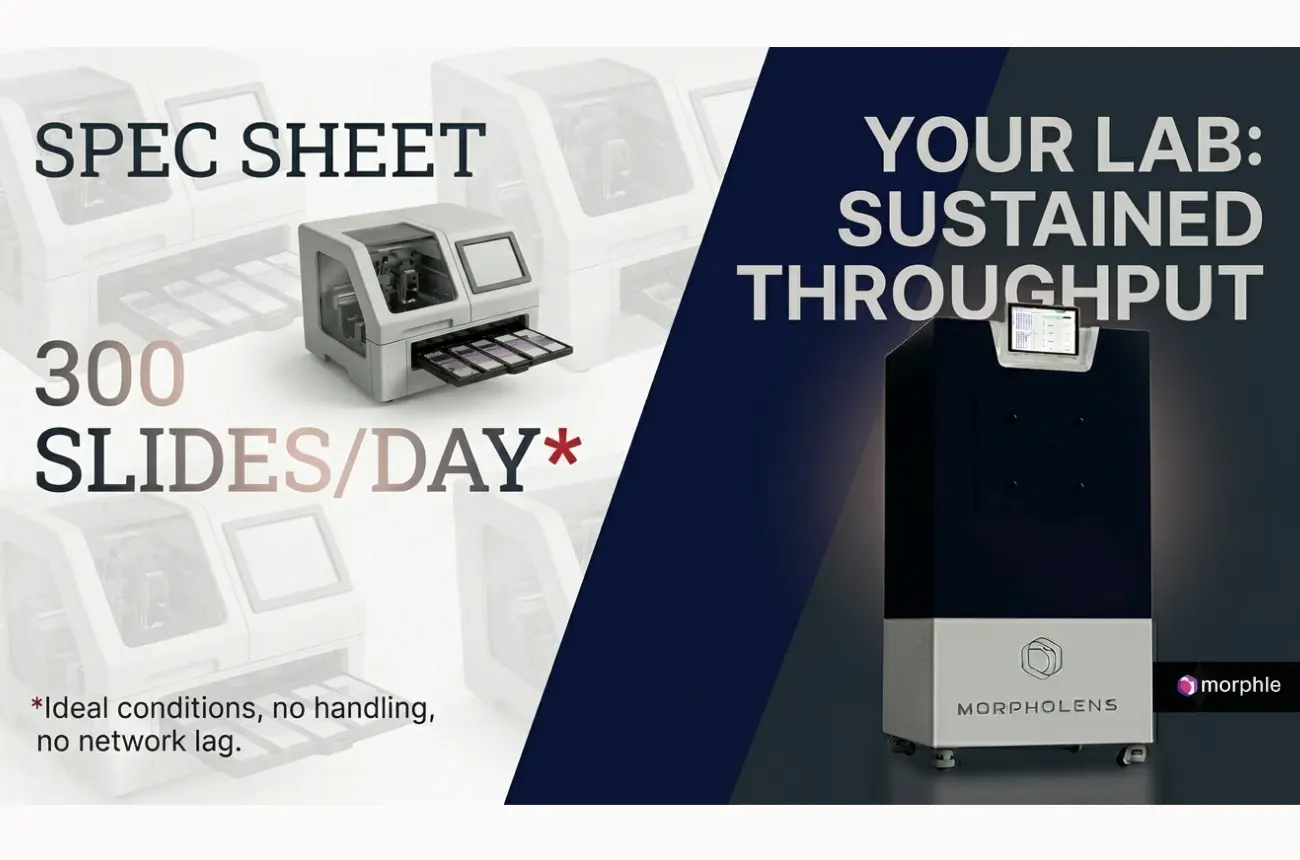
Scan Speed — How quickly does the scanner digitize a slide at 40x magnification? While faster scan times may improve raw throughput on paper, overly aggressive scanning can introduce focus inconsistencies and image artefacts that require manual review or even rescanning. In diagnostic workflows, consistently high-quality 40x scans that minimize rescans and reviewer uncertainty often deliver better end-to-end efficiency than marginally faster initial scan times.
Optical Resolution —At 40x magnification, native resolution typically ranges around ~0.25 µm/pixel. Systems offering finer resolution (~0.22 µm/pixel) may improve visualization of subtle morphological features in digitally scanned slides.
Throughput Capacity — Single-slide scanners work for research settings; clinical labs often need automated batch loading with 100+ slide capacity to maintain efficiency.
Focus Quality — Ask about z-stack capability and focus map accuracy. Poor focus algorithms result in blurry regions that can compromise diagnosis.
File Format Compatibility — Ensure the scanner outputs open or widely supported formats (SVS, NDPI, TIFF) compatible with your image management software and AI tools.
Connectivity and LIS Integration — A scanner that cannot speak to your Laboratory Information System creates manual workaround workflows. Verify API availability and integration support upfront.
The applications of an automated microscope slide scanner span a wide range of clinical and research disciplines.
Slide Scanner Histology — Digitizing stained tissue sections (H&E, IHC, special stains) for pathologist review. Slide scanner histology workflows benefit enormously from consistent digitization and the ability to archive slides without physical degradation.
Oncology and Tumor Boards — Sharing high-resolution WSIs across multi-disciplinary teams, reducing turnaround times and enabling second opinions without physically transporting glass slides.
Research and Drug Development — Pharmaceutical and academic researchers use pathology slide scanners to quantify biomarkers, assess drug efficacy, and build AI training datasets at scale.
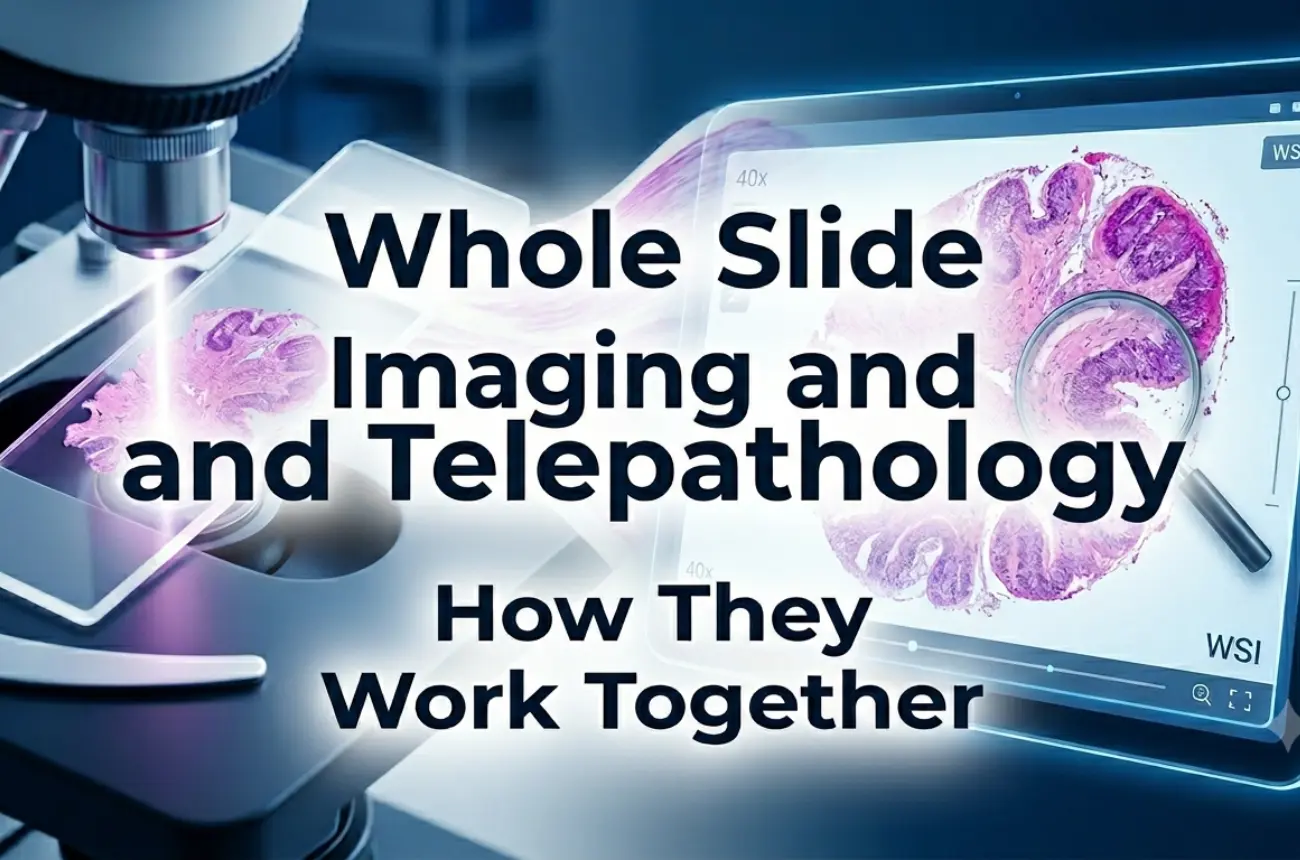
Telepathology — Remote pathology consultations, especially in underserved regions, rely on robust whole slide scanning to transmit case-ready images to specialists anywhere in the world.
Education and Training — Medical schools and residency programs use digital slides to train the next generation of pathologists without consuming irreplaceable physical tissue archives.
Whether you're comparing digital pathology scanner price points across vendors or evaluating support quality, use this checklist before signing anything.
Space is evolving fast. Forward-looking labs should watch for AI-assisted analysis embedded directly into scanner workflows, enabling real-time tissue classification and biomarker quantification at the point of scan. Cloud-native architectures are making institution-wide WSI libraries accessible from any device without expensive on-premises infrastructure. Multiplexed imaging platforms now support simultaneous capture of multiple biomarkers from a single slide, opening new possibilities in spatial biology. And federated learning is enabling digital pathology companies to collaborate on AI model training across institutions; without sharing patient data, thanks to standardized digital slide formats.
When evaluating digital pathology companies, Morphle Labs consistently earns recognition for one reason: they build robust scanners that just work, and they back them with a team that genuinely cares about your success.
Morphle's digital pathology scanners are engineered for real-world lab environments, not controlled demos. Their systems deliver consistent, high-quality whole slide images across a wide range of tissue types and staining protocols, with the speed and reliability that high-volume labs demand. The hardware is purpose-built, but it's the software and integration layer that sets Morphle apart: an intuitive interface that minimizes the learning curve, seamless LIS connectivity, and a platform designed to scale with your needs.
Beyond the product, Morphle's reputation is built on ease of use and exceptional support. Labs that work with Morphle consistently highlight the responsiveness of the team as a key differentiator, fast answers, proactive updates, and a support structure that feels more like a partnership than a vendor relationship. When something needs attention, Morphle's team is there.
Whether you're a regional hospital entering digital pathology for the first time or a research institution scaling up to enterprise-level scanning, Morphle Labs offers a solution that is purpose-fit, competitively priced, and backed by people who understand pathology workflows from the inside out.
Don't let outdated glass-slide workflows slow down your diagnostics. Explore Morphle Labs' line of automated slide scanners , purpose-built for clinical and research environments, easy to deploy, and backed by a responsive team that's with you every step of the way.


.webp)
.webp)
.webp)
.webp)
.webp)
.webp)